 Sudden Valley Roofing
 Why This Question Comes Up So Often Here
If you own a home in Sudden Valley, you already know your roof works harder than roofs in drier parts of the state. Lake Whatcom sits right next to you, the marine air rolls in off the Puget Sound region, and the tree canopy that makes this area beautiful also means near-constant shade on large sections of most roofs. That combination of moisture, salt-tinged air, and shade is exactly the environment where moss takes hold and asphalt shingles wear out faster than their rated lifespan suggests. So it's a fair question: does it make sense to switch to metal, or pay more up front to avoid re-roofing again in fifteen years?
There's no single right answer for every house. Metal roofing is a genuinely good product for this climate, but it's not automatically the right call for every budget, roof shape, or homeowner. This page walks through how metal actually performs against Whatcom County conditions, what it costs relative to other options over time, and where it tends to make the most sense.
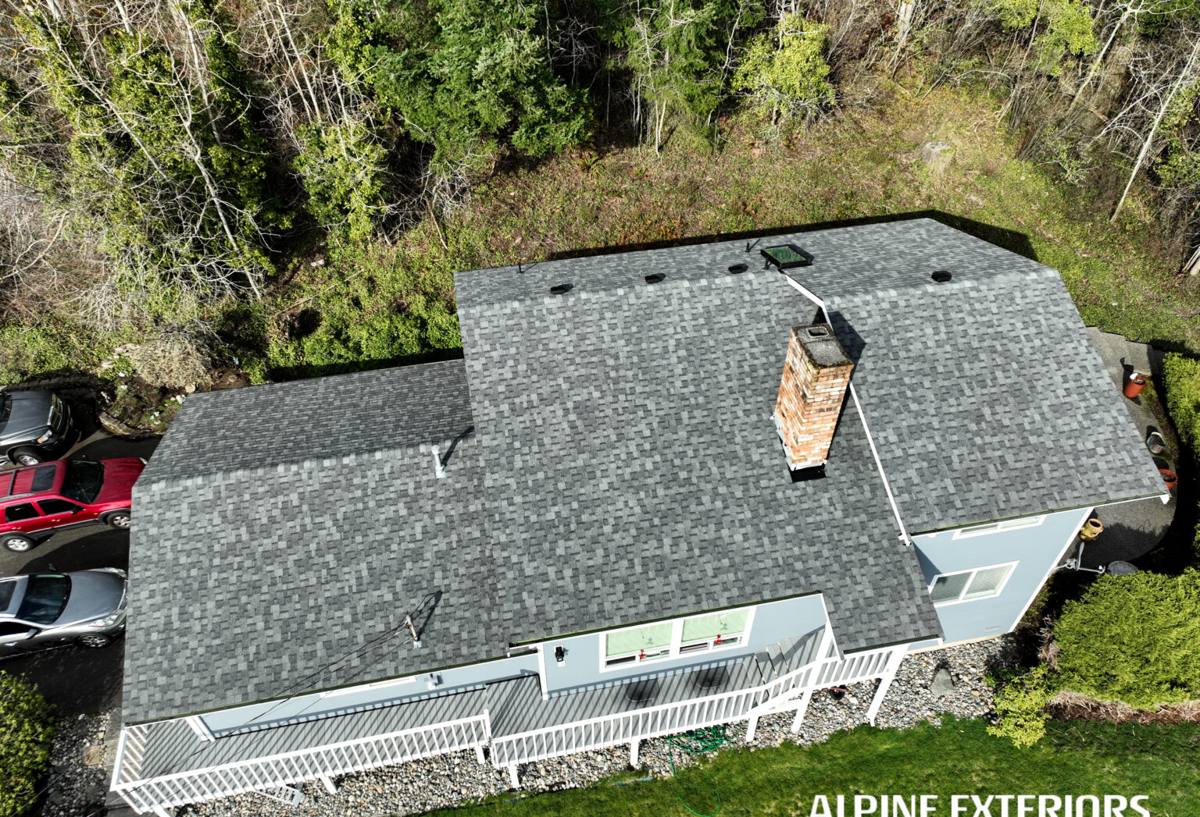
What "Metal Roofing" Actually Means
Homeowners often use "metal roof" as a catch-all, but there are a few distinct systems, and the differences matter for both cost and long-term performance.
| Type | How It's Installed | Typical Fit |
|---|---|---|
| Standing seam | Concealed fasteners under raised interlocking panel seams | Most durable option; higher upfront cost |
| Exposed fastener panel | Screwed directly through the panel face into the deck | Lower cost, but fasteners need periodic checking |
| Stone-coated steel | Steel panels formed and coated to resemble shingle or tile profiles | Good middle ground on cost and appearance |
Each of these sheds water differently and has different maintenance needs, which we'll get into below. When a contractor quotes "metal roofing," always ask which system they mean — the price and the long-term care are not the same across the three.
How Metal Holds Up Against Local Conditions
Salt Air and Coastal Moisture
Whatcom County isn't directly on the open coast, but the marine influence off the Sound still puts a fine layer of salt-tinged moisture on exterior surfaces, especially closer to the water. Bare or poorly coated steel can corrode over time in that environment. This is why the coating matters more than the base metal — galvanized and especially galvalume-coated steel, along with aluminum (which doesn't rust at all), are the sensible choices here. A cheap, thin coating on an otherwise good panel is where corrosion problems start.
Driving Rain
Standing seam panels with properly lapped seams are about as good as it gets for shedding heavy, wind-driven rain — there are no exposed fastener penetrations for water to work its way through over time. Exposed-fastener panels can perform well too, but every screw is a potential entry point if the neoprene washer degrades or the screw backs out, which is more likely to happen on a roof that sees this much annual rainfall.
Moss Season
This is where metal has a real, honest advantage. Moss needs a rough, porous surface and consistent moisture to establish itself, and it does that very well on asphalt granules. A smooth metal panel gives moss spores almost nothing to grip, and the steep, slick surface of most metal profiles sheds spores and debris before they can settle in. Metal roofs still need occasional debris clearing in shaded, tree-covered lots — moss can still build up in valleys and against transitions where organic debris collects — but it's a fundamentally harder surface for moss to colonize than shingles.
Upfront Cost vs. Lifetime Cost
Metal costs more to install than asphalt shingles, and it's worth being upfront about that instead of glossing over it. The real comparison isn't the install price alone — it's the install price divided by how long the roof actually lasts, plus how much maintenance it needs in between.
| Factor | Asphalt Shingle | Metal (standing seam or stone-coated) |
|---|---|---|
| Typical lifespan | 18–25 years in this climate | 40–60+ years |
| Upfront cost | Lower | Roughly 2–3x shingle cost |
| Moss/algae maintenance | Regular treatment or cleaning recommended | Minimal; occasional debris clearing |
| Re-roof frequency over 50 years | 2–3 replacements | Often 0–1 |
| Insurance/energy considerations | Standard | Some insurers and utilities offer discounts for metal or reflective roofing |
Whether the math favors metal depends on how long you plan to stay in the home. If you're planning to sell within five years, the upfront cost is harder to justify on economics alone, though it can still be a selling point. If you're building or planning to stay long-term, the lifetime-cost picture usually favors metal, especially once you factor in avoiding one or two future tear-offs and reduced moss maintenance over the years.
Where Metal Makes the Most Sense in Sudden Valley
Roof Pitch and Shape
Metal performs best on moderate-to-steep pitches where it can shed water and debris quickly. Very low-slope sections or complex rooflines with lots of valleys and penetrations need careful detailing regardless of roofing material, and a contractor should walk you through how those areas will be flashed before you commit to metal.
Tree Cover and Shade
Heavily shaded lots — common throughout Sudden Valley given the tree canopy — are exactly where moss and moisture retention cause the most trouble for shingles. This is the scenario where metal's advantage is most noticeable, since it removes one of the two ingredients (a rough surface) that moss needs to take hold.
Home Style and Neighborhood Fit
Standing seam has a distinct look that reads as modern or cabin-style depending on color and trim. Stone-coated steel panels are designed to mimic shingle or shake profiles more closely, which can be the better fit if you want the moss and durability benefits of metal without changing your home's overall look. If your property is subject to an HOA or design covenant, check requirements before finalizing a material.
What to Watch Out For
Metal roofing has a few trade-offs that are worth knowing about honestly, rather than glossed over by anyone trying to sell you a system.
- Installation sensitivity: Metal roofing performance depends heavily on correct installation — panel spacing, fastener torque, and flashing details all matter more than with shingles, where minor errors are more forgiving.
- Fastener maintenance: Exposed-fastener systems need their screws checked periodically, since washers can degrade and screws can back out over decades of thermal expansion and contraction.
- Noise perception: With proper decking and underlayment, metal roofs are not noticeably louder in rain than shingle roofs — this is a common misconception, not a real drawback when installed correctly.
- Condensation: Metal needs proper ventilation and underlayment to prevent condensation forming on the underside of panels in cold, damp weather, which is a real consideration in our winters.
- Repair matching: If a panel is ever damaged, matching the exact profile and color years later can be harder than replacing a few shingles, so keeping leftover material or accurate specs on file is worth doing.
Maintenance Checklist If You Go With Metal
Metal roofs are lower-maintenance than shingles, but "low" isn't "none." A short annual routine keeps a metal roof performing for its full lifespan.
- Clear needles, leaves, and debris from valleys and roof-to-wall transitions, especially after fall
- Check that gutters and downspouts are flowing freely, since clogged gutters can back water up under panel edges
- Look for any lifted or loose fasteners on exposed-fastener systems, particularly after high winds
- Inspect flashing around chimneys, vents, and skylights for sealant that has dried or cracked
- Watch for any scratches through the coating near ladders, satellite mounts, or foot traffic areas, since exposed steel can corrode faster than coated panels
Making the Decision
Metal roofing is a strong option for Whatcom County homes, particularly on shaded, tree-covered lots where moss and moisture are the biggest long-term threats to a roof. It costs more upfront, and it demands a contractor who installs it correctly, but the trade-off is decades of reduced maintenance and far fewer trips up the ladder to deal with moss and granule loss. Asphalt shingles remain a reasonable, lower-cost choice for homeowners on a tighter budget or a shorter time horizon — it's not that one product is "better" in every case, it's about matching the roof to your roofline, your budget, and how long you plan to own the home.
If you're weighing metal against a shingle replacement for your Sudden Valley home, we're happy to take a look at your specific roof — pitch, shade exposure, and current condition all factor into the recommendation. Reach out for a free, no-pressure estimate and we'll walk you through what makes sense for your property.