 Sudden Valley Roofing
 Why Edgemoor's Location Puts Extra Demands on Siding
Edgemoor sits close enough to Bellingham Bay that salt-laden air is a regular part of the weather, not an occasional event. Add in the driving rain that comes off the water during fall and winter storms, plus the long, damp moss season that Whatcom County is known for, and you have a combination that wears down siding faster than it would inland. Salt air accelerates corrosion on fasteners and trim, wind-driven rain finds every gap in a lap joint or butt seam, and shade from mature trees keeps north- and west-facing walls damp long after a storm has passed. None of this is unusual for the area — it's just the baseline that any siding on an Edgemoor home has to hold up against, year after year.
The practical result is that siding choice and installation quality matter more here than they would in a drier, more sheltered part of the county. A product or installation that's marginal in a dry climate can fail outright in a wet one. That's the lens we use on every Edgemoor project.
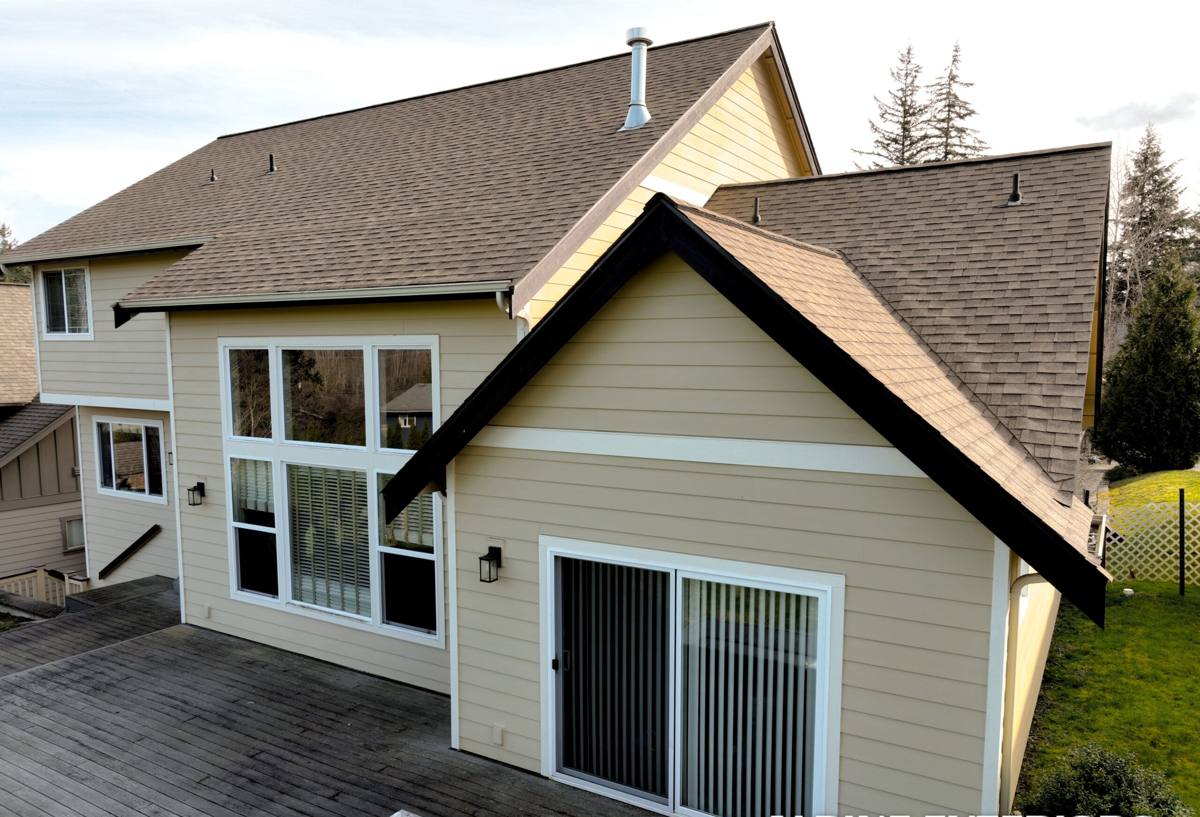
What Correct Fiber Cement Installation Requires in This Climate
Moisture Management Comes First
Fiber cement siding is not a waterproof membrane — it's a cladding that sheds bulk water while a separate drainage plane behind it handles anything that gets past the surface. In a climate with sustained wind-driven rain, that drainage plane, the flashing details around windows and doors, and the weep path at the bottom of the wall matter as much as the siding itself. Skipping or shortcutting any of these is the single most common reason siding fails early, and it has nothing to do with the brand of board on the wall.
Fastening and Clearances
James Hardie specifies exact nailing patterns, fastener types, and minimum clearances from grade, roof lines, and decks. Those numbers aren't arbitrary — they account for how much a board can move, how water sheds off the bottom edge, and how much exposure the cut ends get. In a salt-air environment, fastener material matters too; the wrong fastener corrodes faster and can streak or stain the face of the siding well before the siding itself shows wear.
Caulking and Joint Treatment
Every butt joint, corner, and penetration is a place water can enter if it isn't detailed correctly. Manufacturer specs call for factory-primed or ColorPlus-finished cut edges to be sealed, and for joints to be either shiplapped, flashed, or caulked with a product rated for the application — not whatever caulk happens to be in the truck. This is detail work, and it's exactly the kind of step that gets skipped when a crew is moving fast.
Why We Install Only James Hardie Fiber Cement
We standardized on James Hardie products years ago and we don't install LP SmartSide, vinyl, Cemplank, Allura, primed spruce, or cedar. That's a deliberate choice, not a brand preference we picked at random.
- Non-combustible core. Hardie's fiber cement won't ignite or contribute fuel to a fire the way wood-based or engineered-wood products can.
- Factory-applied ColorPlus finish. The finish is baked on under controlled conditions rather than field-applied, which gives more consistent color and better adhesion than job-site painting.
- Climate-engineered product lines. Hardie makes HZ5 and HZ10 formulations specifically for wet, moisture-heavy climates like ours, rather than a single one-size-fits-all board.
- A warranty structure that transfers. Hardie's warranty is well-documented and transfers to a new owner if the home sells, which matters for resale in a market like Edgemoor's.
- A long track record when installed to spec. Fiber cement has been in wide use long enough that we know how it performs over decades, not just years.
We're not going to tell you other products are junk — LP SmartSide, vinyl, and cedar each have real advantages depending on budget and goals. But we made a professional call that we'd rather install one product system correctly, know its behavior cold, and stand behind it fully, than spread our crews thin across five different materials with five different failure modes. For coastal Whatcom County homes, that product is Hardie.
How Fiber Cement Compares to the Alternatives Here
| Material | How It Handles Salt Air & Rain | Long-Term Maintenance |
|---|---|---|
| James Hardie fiber cement | Non-combustible, engineered moisture resistance, factory finish holds color | Occasional wash; repaint only if ever needed, typically well past a decade |
| Vinyl | Sheds water but can warp, crack, or fade with UV and temperature swings; seams can loosen | Low upkeep but limited repair options if damaged; color can't be refreshed |
| Cedar | Attractive but absorbs moisture; prone to rot and moss growth in damp, shaded areas | Regular refinishing, sealing, and moisture monitoring required |
| LP SmartSide (engineered wood) | Treated to resist moisture but still wood-based; edge sealing is critical | Periodic inspection of cut edges and joints; repainting on a cycle |
This isn't about declaring a single winner for every homeowner. It's about being honest that in a marine, high-moisture environment, the materials that depend on paint film or edge sealing to stay dry carry more ongoing risk than a product engineered around moisture resistance from the start.
Our Process on an Edgemoor Project
- On-site assessment. We look at wall orientation, tree cover, existing moisture damage, and how the home currently handles wind-driven rain before we talk product.
- Tear-off and inspection of the wall behind the old siding. This is where hidden rot, damaged sheathing, or missing house wrap gets found and addressed — before new siding goes up, not after.
- Weather-resistive barrier and flashing. We install or repair the drainage plane and flash every window, door, and penetration to manufacturer spec.
- Hardie installation to spec. Correct nailing pattern, correct clearances from grade and roofline, correct joint treatment.
- Final detailing. Caulking, touch-up, and a walk-through so you know what was done and why.
Cost Factors for an Edgemoor Home
| Factor | Why It Affects Price |
|---|---|
| Home size and wall complexity | More corners, gables, and dormers mean more cutting, flashing, and labor time |
| Condition of existing sheathing | Rot or moisture damage found during tear-off adds repair scope before siding can go on |
| Siding profile chosen | Lap siding, shingle-style panels, and board-and-batten each have different material and labor costs |
| Trim and accessory scope | Corner boards, window trim, and fascia work are often bundled with a siding project |
| Access and site conditions | Slopes, mature landscaping, or limited staging area near the water can add labor time |
We won't quote a number without seeing the home, but we'll give you a clear, itemized estimate so you know exactly what you're paying for and why.
Maintenance Checklist for Edgemoor Homeowners
Even correctly installed fiber cement benefits from a little seasonal attention in this climate:
- Rinse salt residue off exterior walls once or twice a year, especially on sides facing open water or exposed to wind
- Check caulking at joints, corners, and around windows annually and re-caulk any cracked or missing sections
- Keep gutters clear so water doesn't overflow and run down the wall face
- Trim back vegetation and tree limbs that keep siding shaded and damp for long stretches, which encourages moss and mildew
- Look at the bottom few feet of siding near grade and decks for staining or softness, which can signal a clearance or drainage issue
- Address any small paint chips or exposed cut edges promptly rather than waiting for a full repaint cycle
Why Local Experience with Edgemoor Homes Matters
A crew that regularly works this part of Whatcom County already knows which walls in Edgemoor take the worst of the wind and salt spray, how much shade and moisture a given lot typically holds through the moss season, and which flashing details tend to get missed on homes built in different eras. That's not something you can fully replicate from a general specification sheet — it comes from doing the work here repeatedly and paying attention to what actually happens to a wall five or ten years after installation. It also means we're not guessing about product selection or detailing; we're applying what we've already confirmed works in this exact climate.
Hiring locally also matters for accountability. A warranty is only as good as the contractor standing behind it, and a company that's established in the area has a reputation to protect and is easy to reach if a question comes up years down the road.
Ready to Talk About Your Home
If your Edgemoor home's siding is showing its age, or you're planning ahead before the next wet season sets in, we're happy to take a look and walk you through what correct fiber cement installation would involve for your specific walls and exposure. Reach out for a free, no-pressure estimate using the form below.