 Sudden Valley Roofing
 Why Lake Whatcom Wears Out a Roof Differently
A roof on Lake Whatcom doesn't age the same way one does twenty miles inland. Homes around Sudden Valley sit tucked under heavy evergreen canopy, close to the water, and that combination of shade and near-constant dampness is hard on asphalt, wood, and even the fasteners holding everything together. Add Whatcom County's long, wet fall-through-spring stretch and the salt-laden marine air that moves in off the Puget Sound and Salish Sea, and you get a roof that needs a different set of decisions made at replacement time than a roof going on a house in a dry, open subdivision.
Moss, Algae, and a Long Wet Season
Moss doesn't need much encouragement here. Shaded, north-facing slopes and the low, tree-covered valleys common on lake lots stay damp for weeks at a stretch, and moss takes hold in those conditions faster than most homeowners expect. Once it's established, it lifts shingle tabs, traps water against the roof deck, and accelerates granule loss — all of which shortens the life of a roof that would otherwise last two decades or more.
Driving Rain and Wind Off the Water
Lake basins generate their own wind patterns, and Sudden Valley gets its share of wind-driven rain that doesn't just fall straight down — it pushes sideways and works its way up under shingle edges and around poorly lapped flashing. Valleys, low-slope sections, and anywhere two roof planes meet are where this shows up first if the original installation cut corners.
Marine Air and Metal Components
Whatcom County's proximity to the Sound means salt-bearing air reaches even inland lake communities. It's not something most homeowners think about, but it corrodes exposed fasteners, drip edge, and flashing faster than you'd see in a drier, more inland climate. That's a real factor in what metal and fastener grade we choose for a Lake Whatcom roof.
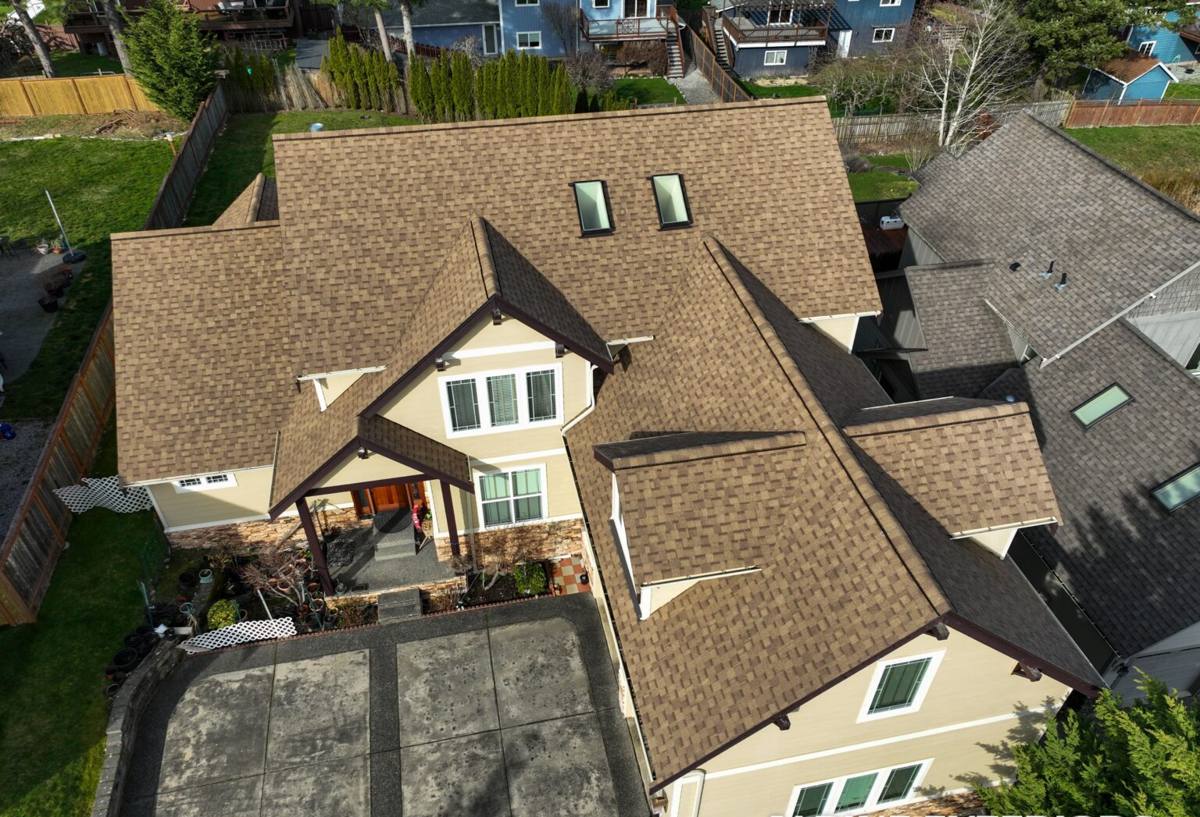
Signs a Lake Whatcom Roof Needs Replacement, Not Another Repair
Plenty of roofs get patched for years past the point where patching still makes sense. Here's what tells us a full replacement is the honest recommendation rather than another repair:
- Granules collecting heavily in gutters and at the base of downspouts
- Moss established across multiple slopes, not just one shaded corner
- Soft spots, sponginess, or visible sagging when walked
- Daylight visible through the roof deck, or dark staining on rafters and sheathing in the attic
- Shingles curling, cracking, or blown off after wind and rain events
- A comp shingle roof approaching or past its 20-25 year mark
- The same leak has been repaired more than once in the same spot
If you're only seeing one or two of these, a targeted repair may still be the right call — we'll tell you that if it's true.
What a Correct Roof Replacement Involves
A roof replacement is only as good as what's underneath the new shingles. On a lake property where moisture exposure is higher than average, the details matter more, not less.
Tear-Off and Deck Inspection
A full tear-off exposes the deck so we can actually see what years of moss and moisture have done to the sheathing. Soft, delaminated, or rotted plywood gets replaced before anything new goes down — covering over bad decking is how a new roof fails early.
Underlayment and Water Barrier
Given how much wind-driven rain this area sees, we treat the water barrier as more than a formality. Self-adhering ice-and-water membrane goes at eaves, valleys, and around every penetration, with synthetic underlayment across the rest of the field for a roof that resists moisture intrusion even if wind pushes rain up under the shingle line.
Ventilation
Trapped attic moisture is a major contributor to premature sheathing rot and to moss thriving on the underside of a roof deck. We check intake and exhaust ventilation as part of every replacement and correct it when it's undersized or blocked, rather than just installing a new roof over the same airflow problem.
Flashing and Penetrations
Chimneys, skylights, vent pipes, and wall-to-roof transitions are where most leaks actually start. New step flashing, counter-flashing, and pipe boots — properly lapped, not just caulked — matter more on a lake lot than almost anything else we do.
Choosing Materials for This Climate
There's no single "best" roofing material for every Lake Whatcom home — it depends on your roof's exposure, your budget, and how much upkeep you want to take on. Here's how the common options compare for this specific climate:
| Material | Moss & Algae Resistance | Wind/Rain Performance | Maintenance | Typical Lifespan |
|---|---|---|---|---|
| Architectural asphalt shingle | Moderate; improves with algae-resistant granules | Good when installed with proper nailing and sealant strips | Periodic moss treatment on shaded slopes | 25-30 years |
| Standing seam metal | Very good; sheds moisture, little for moss to grip | Excellent in wind and driving rain | Low; occasional fastener and sealant check | 40-50+ years |
| Synthetic/composite shingle | Good; resists moisture absorption better than wood | Good | Low to moderate | 30-40 years |
We don't install untreated cedar shake on lake-shaded roofs as a matter of professional standard — the maintenance burden and moisture behavior in this kind of shade and rainfall just don't line up well with what most homeowners want out of a roof, even though it's a legitimate product elsewhere.
How We Approach a Lake Whatcom Roof Replacement
The process is straightforward, but the details are where a job either holds up or doesn't.
- On-site inspection of the deck, attic ventilation, flashing, and current moss/moisture damage
- A written estimate that spells out material, scope, and any deck repair allowance — no vague verbal numbers
- A walk-through of material options based on your roof's exposure and your budget
- Scheduling around Whatcom County's weather windows, since tear-off days need a dry stretch
- Property protection during tear-off — tarping landscaping, protecting driveways and any lake-adjacent areas from debris
- Deck repair, new water barrier, flashing, and material installation in that order, with no shortcuts skipped to save a day
- A magnetic sweep and full site cleanup before we consider the job done
- Final walk-through with you and warranty paperwork handed over, not mailed later
What Drives the Cost of a Lake Whatcom Roof Replacement
Every roof is priced on its own specifics, but these are the factors that move the number most on a lake property:
| Cost Factor | Why It Matters Here |
|---|---|
| Roof pitch and access | Steep lakeside lots and limited driveway access can require extra staging and safety setup |
| Roof size and layout | Square footage plus the number of valleys, dormers, and planes affects labor time |
| Layers to remove | A roof with a prior layer added over the original takes longer to tear off and haul away |
| Deck repair needed | Moss and moisture damage found during tear-off is priced as it's discovered, not guessed upfront |
| Material choice | Asphalt, metal, and synthetic products carry different material and labor costs |
| Penetrations | Chimneys, skylights, and multiple vents each add flashing work |
| Disposal | Tear-off debris volume and haul distance factor into the total |
Why Local Experience on Lake Whatcom Matters
Sudden Valley isn't a typical subdivision. Lots are often sloped down toward the water, driveways can be narrow, and tree canopy limits staging space in ways a crew unfamiliar with the neighborhood doesn't plan for well. A crew that already works this area knows how to set up safely on these lots, how to schedule tear-off around Whatcom County's wetter months, and how to keep debris and runoff away from the lake during the job. If your home falls under a homeowners' or community association's exterior guidelines, we're used to working within those requirements rather than treating them as a surprise mid-project. That local familiarity shows up as fewer delays and fewer surprises on your invoice, not just a nicer sales pitch.
Keeping Your New Roof Performing After Installation
A correctly installed roof still needs a little seasonal attention in this climate. Gutters clogged by falling needles and leaves from lakeside trees hold water against the fascia and roof edge, so clearing them before the wet season matters more here than in more open areas. A light moss treatment on shaded, north-facing slopes every year or two keeps growth from re-establishing, and a quick visual check of flashing around chimneys and vents after major windstorms catches small issues before they become leaks. We're happy to walk you through a simple maintenance schedule when the job wraps up.
If your roof is showing its age or you're just not sure whether it needs repair or full replacement, we'll take a look and give you a straight answer. Reach out for a free, no-pressure estimate using the form below.