 Sudden Valley Roofing
 Siding Repair Built for Lake Whatcom's Climate
Homes around Lake Whatcom face a different set of pressures than siding fifty miles inland. The lake moderates temperature but adds constant humidity, driving rain comes in sideways off the water during fall and winter storms, and the tree cover that makes this part of Whatcom County beautiful also means shade, dampness, and moss that never really lets up from October through April. Add in the faint but real salt-air influence that reaches inland from the Puget Sound corridor, and you have a combination that finds every weak point in a home's exterior. Siding that's marginal in Bellingham proper often fails faster out here.
We work Sudden Valley and the Lake Whatcom shoreline regularly, which means we've seen how local siding actually ages — not in a lab, but on real homes exposed to this exact microclimate. That local pattern recognition is worth more than a generic repair quote, because it tells us where to look first and what's likely hiding under a small problem.
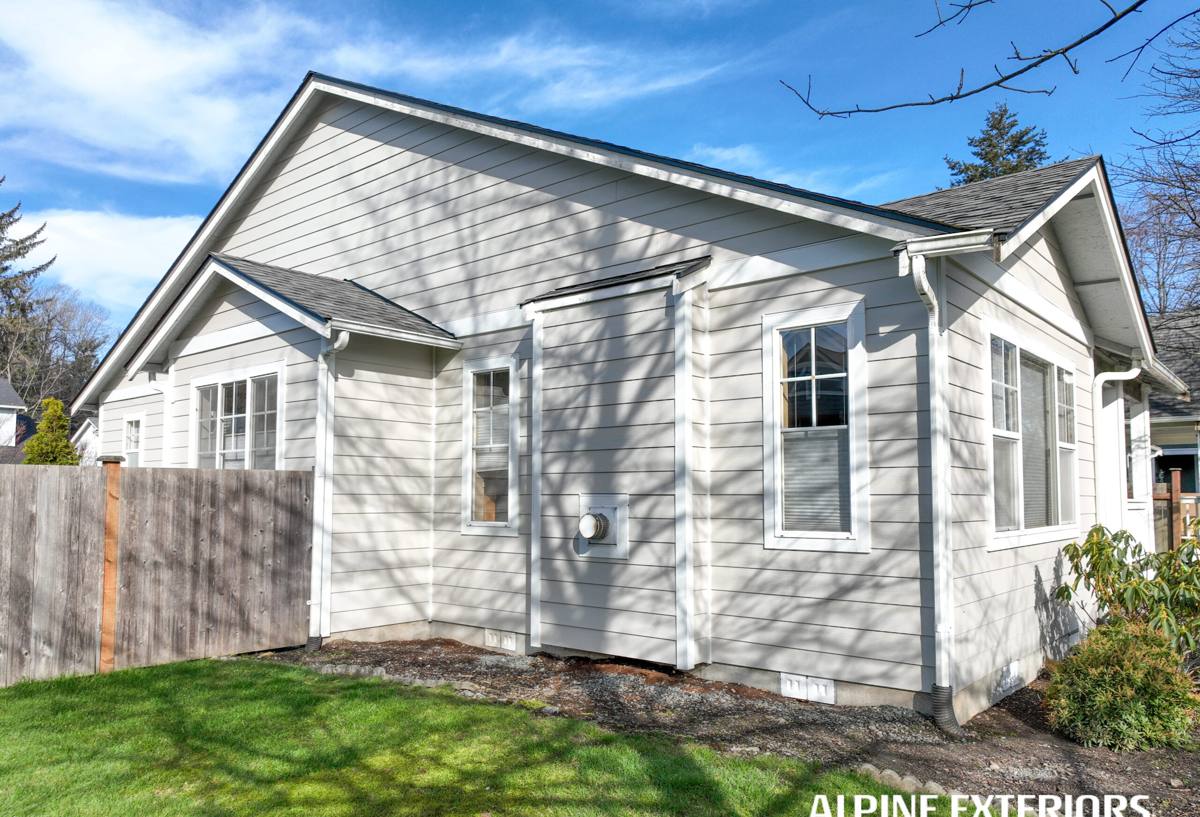
Why Siding Fails Faster Here Than Elsewhere in the County
Moisture That Never Fully Dries
Lake-adjacent lots hold moisture longer than open, sun-exposed sites. Morning fog off the water, shade from mature Douglas fir and cedar, and steep, tree-lined lots all slow down drying time after rain. Wood-based sidings — cedar, primed spruce, and even engineered wood products — depend on drying cycles to stay stable. When those cycles get interrupted for months at a time, moisture works its way behind panels, around fasteners, and into seams, and rot follows even when the surface still looks okay.
Moss and Organic Growth
Moss isn't just cosmetic. Once it establishes on a siding surface or in a seam, it holds water against the substrate around the clock, not just during storms. On wood-based products, that constant contact accelerates decay right at the point of growth. On vinyl, moss and algae staining creeps into laps and can't be fully cleaned without damaging the panel. Any repair plan out here has to account for the fact that whatever we install will grow moss again — the question is whether the material can tolerate that contact without degrading.
Wind-Driven Rain
Storms crossing the lake pick up speed with little to break them before they hit shoreline-facing walls. That drives rain up under laps and around trim in a way that calmer, more sheltered lots don't experience. Repairs that don't correctly re-flash and re-lap after patching a section often leak again within a season or two, just in a spot that's harder to spot.
What a Correct Siding Repair Actually Involves
A siding repair that holds up around Lake Whatcom is not just "replace the damaged board." Done right, it's a small diagnostic project every time:
- Find the actual source — damaged siding is usually a symptom. We check flashing, caulking, and the water path above and around the damaged area before touching the siding itself.
- Check the sheathing and framing behind the panel — if moisture has been sitting for a while, the plywood or OSB sheathing underneath may be soft. Replacing siding over compromised sheathing just hides the problem.
- Inspect for moss and organic buildup in adjacent seams — even if it's not the cause of this repair, it's often the cause of the next one if left alone.
- Match or upgrade the material — patching cedar with cedar, or vinyl with vinyl, just continues the same failure pattern. We're candid with homeowners when a "small repair" is really a sign the whole wall section should move to a more climate-appropriate material.
- Re-flash and re-lap properly — every new seam created by a repair is a new place water can get in if it isn't lapped and sealed to shed water correctly, top to bottom.
Our Repair Process
- On-site assessment — we walk the affected area and the surrounding wall, not just the damaged board, looking for the moisture path and any secondary damage.
- Probe for hidden rot — soft-testing the sheathing and framing around the visible damage tells us how far the repair actually needs to go.
- Written scope before work starts — you'll know exactly what's being replaced, what material we're using, and why, before any siding comes off.
- Remove and replace — damaged material comes out, sheathing repairs happen if needed, and new siding goes in with correct flashing and fastening.
- Final weatherproofing check — laps, caulking, and flashing get inspected as a system, not just at the repair site, since a fix that leaves a neighboring seam vulnerable isn't really finished.
Why We Only Install James Hardie Fiber Cement
When a repair calls for replacing more than a board or two, or when a homeowner asks what to switch to, we recommend James Hardie fiber cement siding — and we don't install anything else. That's a deliberate standard, not a sales position, and it's worth explaining given the climate we're working in.
Cedar and primed spruce are wood. In a shaded, humid, lake-adjacent environment, wood siding depends on paint film integrity and consistent drying to avoid rot — two things this microclimate makes hard to guarantee. Vinyl siding handles moisture differently: it doesn't rot, but it flexes with temperature swings, can crack in cold snaps, and doesn't hold paint or refinishing well if you ever want to change the look. LP SmartSide and other engineered wood products are an improvement over raw cedar in some ways, but they're still wood-fiber based and carry similar moisture sensitivity at cut edges and seams — exactly the kind of detail that's hard to keep perfect on a shoreline lot.
James Hardie fiber cement is non-combustible, doesn't support rot the way wood-based products can, and is engineered specifically for high-moisture climates like ours through its HZ5 product line. The factory-applied ColorPlus finish holds color and resists the kind of fading and moss-staining that shows up fast on shaded lake lots, and it comes with a strong transferable warranty. None of that matters if installation is sloppy, but installed to spec, it's the material we trust to actually hold up to what Lake Whatcom throws at a house year after year.
Material Comparison for This Climate
| Material | Moisture Behavior | Moss/Algae Resistance | Long-Term Maintenance |
|---|---|---|---|
| Cedar / Primed Spruce | Absorbs moisture; depends on paint film and drying cycles | Low — organic growth accelerates decay | Repainting, caulking, and rot inspection ongoing |
| Vinyl | Doesn't rot, but can trap moisture behind panels; flexes with temperature | Moderate — can't be refinished if stained | Low upkeep but limited repair/refinish options |
| LP SmartSide / Engineered Wood | Better than raw wood but still moisture-sensitive at edges | Moderate | Edge sealing and inspection needed |
| James Hardie Fiber Cement | Non-combustible, engineered for high-moisture climates (HZ5) | High — factory finish resists staining | Low; occasional cleaning, no repainting cycle |
What This Costs and What Drives the Price
Every repair is different, and we won't quote a number without seeing the wall, but a few factors consistently drive cost on Lake Whatcom repairs:
- Extent of hidden damage — if sheathing or framing needs replacement, that adds labor and material beyond the visible siding.
- Access — steep, tree-lined, or lakeside-facing walls can require more setup time than a straightforward street-facing wall.
- Material match vs. upgrade — matching an existing non-Hardie product is sometimes possible for a small patch, but if we're recommending a switch to fiber cement for a larger section, that's a different scope and a different conversation.
- Flashing and trim condition — if trim boards or window flashing need attention alongside the siding, it's more efficient to address it in the same visit than to come back later.
Signs You Should Get a Repair Looked At Now
Around the lake, small issues turn into bigger ones faster than in drier parts of the county. Watch for:
- Soft or spongy spots when you press on siding, especially near the bottom of walls or below windows
- Visible moss or dark staining that keeps returning after cleaning
- Gaps opening up at seams, corners, or where siding meets trim
- Peeling or bubbling paint on wood-based siding, particularly on shaded walls
- Any musty smell near an exterior wall from the inside — often the first sign of moisture intrusion before it's visible outside
Why a Local Crew Matters for This Job
Siding repair on paper looks the same everywhere, but the details that make it hold up depend on knowing how a specific area behaves. A crew that works Sudden Valley and the Lake Whatcom shoreline regularly already knows which wall orientations take the worst wind-driven rain, how fast moss reestablishes on shaded lots here versus elsewhere in Whatcom County, and which older siding installations in this area were done without adequate flashing to begin with. That local pattern recognition shortens the diagnostic part of the job and reduces the odds of a repair that looks fine for a season and then fails again in the same spot.
If you're dealing with damaged, aging, or failing siding on a home in Sudden Valley or along Lake Whatcom, we're happy to take a look and give you a straight, no-pressure assessment of what's actually going on and what it would take to fix it right. Use the form below to request a free estimate.