 Sudden Valley Roofing
 Why Sehome's Siding Takes a Different Kind of Beating
Sehome sits close enough to Bellingham Bay that homes here pick up salt-laden air moving in off the water, on top of everything else a Whatcom County winter throws at an exterior wall. That combination of salt, near-constant moisture, and a moss season that barely takes a break wears siding down in ways that don't show up the same way twenty miles inland. When we get called out for a repair in this neighborhood, the damage almost always traces back to one of three things: salt, wind-driven rain, or moss and organic growth sitting against the wall longer than it should.
Salt Air and Coastal Moisture
Salt in the air isn't just a coastal curiosity — it's hygroscopic, meaning it pulls moisture out of the air and holds it against whatever surface it settles on. On siding, that means fasteners corrode faster, caulk joints break down sooner, and painted finishes chalk and fade ahead of schedule. It's slow, and it's easy to miss until a section of trim or a butt joint has been sitting wet for months.
Driving, Wind-Driven Rain
Rain in this part of Washington rarely just falls straight down. Wind off the water pushes it sideways, which means laps, corner boards, and butt joints that would stay dry in a calmer climate take on water they were never designed to handle. If the lap spacing, flashing, or caulking on a wall isn't right, that wind-driven rain doesn't stop at the surface — it works its way behind the siding, where it can sit against sheathing for weeks between dry spells.
A Moss Season That Doesn't Let Up
Shaded walls, tree cover, and long stretches of overcast, damp weather add up to a moss and algae season that runs most of the year in Whatcom County. On siding that can't shed moisture quickly, moss holds water against the surface, stains the finish, and — on softer materials — actually breaks down the substrate underneath it over time.
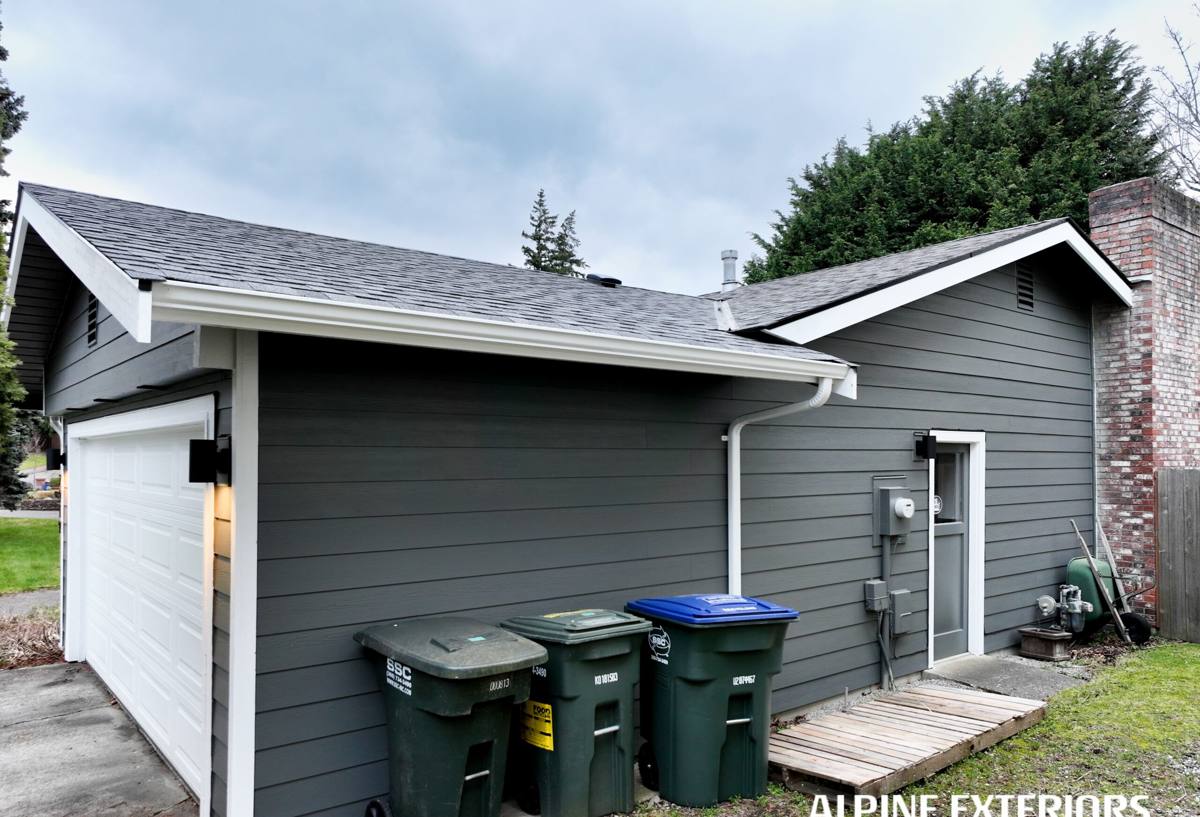
What's Actually Causing the Damage (Not Always What It Looks Like)
Moisture Behind the Siding vs. Surface Wear
A stained or moss-covered board isn't automatically a failed board. Some of what we see is cosmetic — surface staining that cleans off and repaints fine. Other times, what looks like a small cosmetic issue is a sign of moisture that's already gotten behind the siding and started softening sheathing or framing. The two problems look similar from the driveway and require completely different fixes, which is why an honest inspection has to happen before any repair work starts.
Older Materials That Were Never Built for This
A lot of the siding repair calls we get in this area involve older cedar, older OSB-based composite siding, or vinyl that's reached the end of its useful life. None of those materials handle sustained wet, shaded exposure as well as modern fiber cement does. When we're called in for a "repair," part of the job is often figuring out whether the underlying material itself is the real problem — because patching a board that's already failing from moisture intrusion just buys a homeowner a year or two before the same spot fails again.
What a Correct Siding Repair Actually Involves
Finding the Source Before Opening Anything Up
A repair that's done right starts with figuring out why that section failed in the first place — not just patching what's visible. That means checking moisture levels with a meter, tracing water paths back from stained or soft areas, and looking at flashing, caulk lines, and drainage before deciding what actually needs to come off the wall.
Matching Board Profile, Texture, and Finish
Siding repair only looks right if the replacement section matches the board profile, exposure, and texture of what's already on the wall — and if the finish is close enough that the patch doesn't stand out like a bandage. Factory-finished products complicate this in a good way: a properly matched factory color holds up far better over time than a field-painted patch, but it does mean sourcing the right product line and color rather than grabbing whatever's on the shelf.
Our Process for a Sehome Siding Repair Call
- Inspection and moisture check. We walk the affected area, check moisture readings, and identify whether the issue is cosmetic, structural, or both.
- Honest scope, in writing. You get a clear explanation of what's actually wrong, what needs to be replaced versus what can be left alone, and a written estimate before any work starts.
- Repair or targeted replacement. We remove only what needs to come off, address the underlying cause (flashing, caulking, drainage), and install matched replacement material.
- Finish and detail work. Caulk lines, trim, and paint or factory-finish matching are done so the repaired section blends in rather than standing out.
- Final walkthrough. We go over what was done and what to keep an eye on, so there are no surprises later.
Repair or Replace? How We Help You Decide
Not every siding problem calls for a full replacement, and not every problem should be patched. The table below covers the factors we actually weigh on a Sehome-area siding call.
| Factor | Repair Usually Makes Sense | Replacement Usually Makes More Sense |
|---|---|---|
| Extent of damage | Isolated to one or two boards or a single wall section | Showing up in multiple areas, especially different exposures |
| Moisture readings | Localized, sheathing behind it reads dry | Elevated readings spreading beyond the visible damage |
| Age and material | Existing siding is sound fiber cement in otherwise good shape | Original material is older cedar, composite, or vinyl nearing end of life |
| Cause of failure | A fixable detail — bad caulk joint, missing flashing | A systemic issue like poor original installation or water trapped for years |
| Cost over time | Repair cost is a small fraction of full replacement | Repeated repairs are starting to add up to what replacement would cost |
Why We Repair and Replace Only With James Hardie Fiber Cement
Built for a Climate Like This
When a repair does call for new material — whether it's a few boards or a full wall — we install James Hardie fiber cement, and only James Hardie. It's non-combustible, holds up to sustained damp exposure far better than wood-based products, and comes with a factory ColorPlus finish that resists the fading and chalking that salt air and UV accelerate on field-painted siding. Hardie also engineers its product lines for different regional climate exposures, which matters in a place where wind-driven rain, humidity, and moss are a bigger long-term threat than heat.
What We Don't Install, and Why
We don't install LP SmartSide, vinyl, or bare cedar, and we're upfront about why. LP SmartSide is an engineered wood product — it performs well in a lot of climates, but wood-based composites are more sensitive to sustained moisture exposure than fiber cement, and that's exactly the kind of exposure this area delivers most of the year. Vinyl is inexpensive and low-maintenance in the short term, but it can warp, fade, and doesn't hold paint if a homeowner ever wants to change the look. Bare cedar looks great and plenty of homeowners love it, but it demands ongoing staining or sealing to hold up against damp, shaded conditions — skip that maintenance for even a couple of seasons here and it shows. None of this means those products are junk; it means we made a call about what we're willing to stand behind on a wall in this climate, and fiber cement is it.
Why a Local Crew Matters for This Kind of Work
We work throughout the Bellingham area, including Sehome and our home base of Sudden Valley, and that matters more for siding repair than people expect. A crew that already works this part of Whatcom County has seen the typical construction eras and original siding materials used on homes in the area, knows what kind of moisture and moss exposure a given wall orientation is dealing with, and isn't guessing at how the regional climate behaves. That familiarity shortens the diagnostic part of the job and means fewer surprises once a wall is opened up.
Signs Your Siding Needs Attention Now
Most siding problems are easier and cheaper to deal with early. Watch for:
- Soft or spongy spots when you press on a board
- Paint that's bubbling, peeling, or cracking in one localized area
- Persistent dark streaking or moss buildup on shaded or north-facing walls
- Visible gaps opening up at seams, corners, or trim joints
- Boards that appear to be pulling away from the wall or warping
- A musty smell near an exterior wall on the inside of the house
- Rising utility bills that might point to moisture-compromised insulation behind the siding
If you're seeing any of this on a home in Sehome or elsewhere around Whatcom County, it's worth getting a second set of eyes on it before it spreads. We're happy to come take a look, tell you honestly what we see, and put together a free, no-pressure estimate — whether that ends up being a small repair or something more.