 Sudden Valley Roofing
 Energy-Efficient Windows in Cordata: Built for Whatcom County's Weather
Cordata sits within the broader Whatcom County weather system that shapes exterior work across this whole corner of Washington — the same marine-influenced climate that brings salt-tinged air off the Sound, wind-driven rain through most of the year, and a moss and mildew season that runs longer here than it does in drier parts of the state. Windows take the brunt of that weather in a way few other parts of a house do. They're the seam where the conditioned inside of a home meets everything outside, and in this climate that seam is tested constantly by moisture, temperature swings, and salt-carrying air.
Sudden Valley Roofing Co installs, repairs, and replaces windows for homes in Cordata and across Whatcom County, alongside our roofing work. We treat window performance the same way we treat a roof system — as something that either does its job through every season of this climate or slowly fails at it, with no in-between. An energy-efficient window in Cordata isn't just about a lower heating bill. It's about a frame, seal, and glass package that actually holds up to sustained moisture and salt air without losing the performance it was sold with.
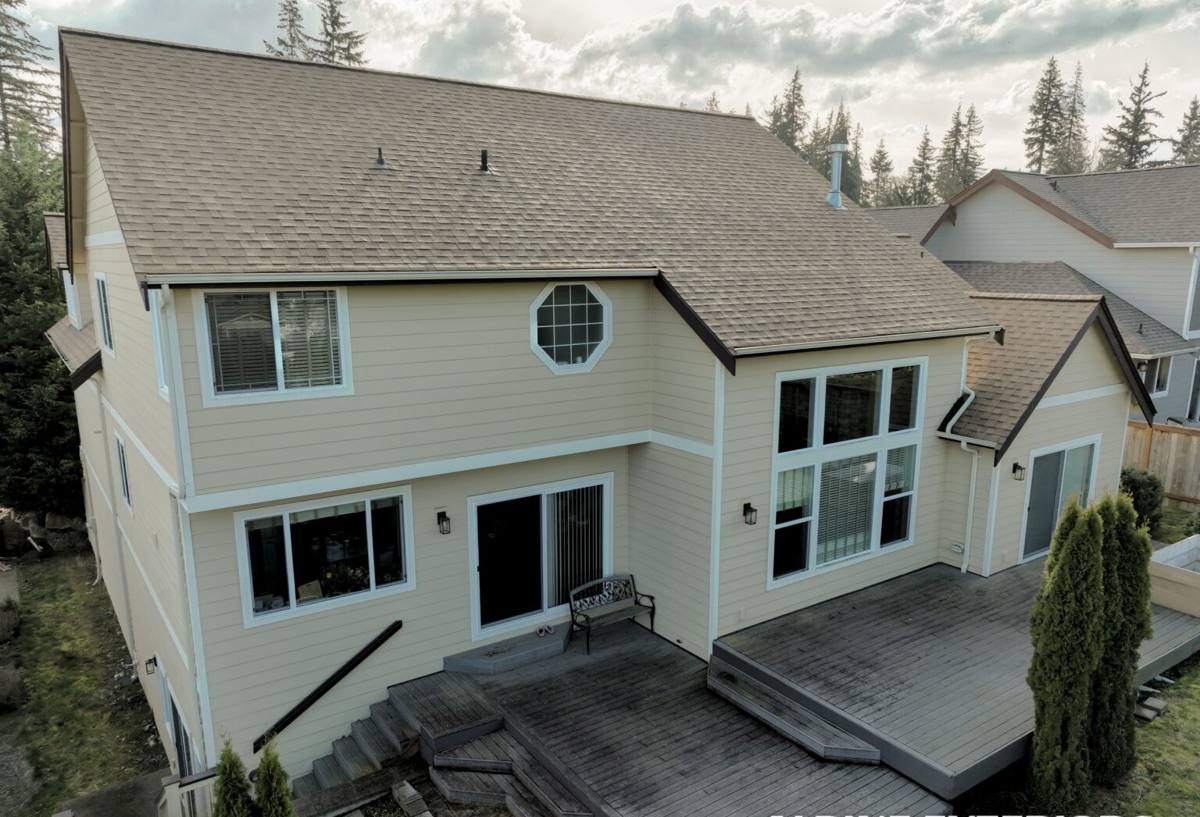
What This Climate Does to Windows in Cordata
Salt Air and Hardware Corrosion
Homes throughout this part of Whatcom County get a steady dose of salt-carrying marine air, and over years that air accelerates corrosion on window hardware, screen frames, and lower-grade fasteners — especially on windows facing prevailing weather. Corroded hardware doesn't just look bad. A latch or lock that's pitted or stiff often means the window isn't closing and sealing the way it did when it was new, and a window that isn't sealing tightly isn't performing energy-efficiently no matter what its original rating said.
Driving Rain and Flashing Failures
Rain in this region rarely falls straight down. Wind pushes it sideways into window flashing, head trim, and the sill pan beneath the frame, and that sideways load is a much bigger test of installation quality than of the window product itself. A high-performance window installed with sloppy flashing will still leak air and water around the frame, undercutting the efficiency it was rated for. A modest window installed with correct flashing and a properly pitched sill pan will actually deliver the performance printed on its label.
A Long Moss and Mildew Season
Shaded walls and window sills that don't drain well hold moisture longer here than they would in a drier climate, which supports mildew growth and, on wood-framed windows, slow rot at the sill and lower corners. Moisture trapped against a frame also degrades the seals and gaskets that keep a window airtight, so a window that's holding dampness at the sill is often losing efficiency well before any rot becomes visible.
What "Energy-Efficient" Actually Means for a Window
"Energy-efficient" gets used loosely in window marketing, but it comes down to a few measurable numbers on the National Fenestration Rating Council (NFRC) label every legitimate window carries:
- U-factor — how well the window resists heat flow. Lower is better; this is the number most directly tied to heating costs in a climate like ours.
- Solar Heat Gain Coefficient (SHGC) — how much solar heat passes through the glass. Matters more on sun-exposed walls than on the shaded, tree-covered lots common in this area.
- Air Leakage — how much air passes through the assembly itself. This number depends as much on installation quality as it does on the window unit.
- Visible Transmittance — how much natural light comes through, which affects whether a more efficient glass package still feels bright inside.
None of these numbers mean much in isolation. A window with an excellent U-factor installed with poor flashing and air sealing will still perform worse in practice than a modest window installed correctly. We look at the whole assembly — glass package, frame material, and installation detail together — rather than selling a number off a spec sheet.
Frame and Glass: What Holds Up and Performs Here
Frame material affects both energy performance and how well a window survives this climate long-term. There's no single right answer for every home — budget, sun exposure, and how long you plan to stay in the house all factor in — but the trade-offs below are the honest starting point for a Cordata property.
| Frame Material | Energy Performance | Moisture & Corrosion Behavior | Typical Maintenance |
|---|---|---|---|
| Vinyl | Good; multi-chamber frames insulate well | Won't rot; seams and welds can degrade if installation quality is poor | Low; occasional track and weep-hole cleaning |
| Fiberglass | Very good; dimensionally stable across temperature swings | Resists moisture and corrosion well | Low |
| Wood, painted or clad | Good natural insulator; performance depends on seal condition | Attractive but vulnerable to moisture at joints and sills without diligent upkeep | Higher; regular paint or finish maintenance |
| Aluminum | Weakest without a thermal break; conducts heat and cold | Can corrode over time in salt-influenced air unless well-finished | Moderate |
On glass, double-pane with a low-emissivity (low-E) coating and an inert gas fill like argon is the standard efficiency package for most homes in this climate, and it performs well when the frame and installation are solid. Triple-pane adds further insulation value and can help with condensation on especially cold-facing glass, but the added cost doesn't pay off for every home — we'll walk through whether it makes sense for your specific walls and budget rather than defaulting to the more expensive option.
Full-Frame vs. Insert Replacement in Cordata
One of the first decisions on any window project is whether to do a full-frame replacement, which removes the old window down to the rough opening and rebuilds the flashing from scratch, or an insert replacement, which fits a new window into the existing frame. Insert replacement is faster, less disruptive to surrounding siding and trim, and often less expensive — and it works well when the existing frame is structurally sound and was properly flashed to begin with. Full-frame replacement costs more and takes longer, but it's the honest answer when there's already moisture damage at the sill or jambs, or when the flashing behind the old window was never done correctly in the first place. Choosing insert replacement over an already-compromised frame just seals an efficiency problem behind a new window instead of fixing it, so we'll tell you which situation you're actually in before recommending either path.
Installation Details That Determine Whether the Energy Savings Actually Show Up
Most of the efficiency gap between a window's rated performance and what a homeowner actually experiences comes down to installation, not product. On every job in Cordata, that means:
- A properly pitched sill pan that sheds water outward instead of letting it pool under the frame
- Head flashing integrated with the housewrap or building paper above the window, lapped correctly for water to shed downward and outward
- Jamb flashing tied into the surrounding wall assembly rather than relying on caulk alone
- Continuous, properly compressed low-expansion foam or backer rod and sealant around the frame — gaps here are where most air leakage actually happens
- Weep holes and drainage paths left clear and functional, not sealed shut during installation
- Corrosion-resistant fasteners and hardware appropriate for a consistently damp, salt-influenced climate
- A final air-seal and operation check on every window before we consider the job done
Skipping any one of these doesn't meaningfully reduce the cost of a job relative to the window itself, but it's exactly what turns a well-rated window into one that drafts, fogs, or leaks within a few years.
Signs a Cordata Home Is Losing Energy Through Its Windows
- Noticeable drafts or a cold spot near a closed window, especially in winter or during wind-driven rain
- Visible fogging or condensation between panes, which usually means a failed seal on a double- or triple-pane unit
- Condensation forming on the inside of the glass regularly, which can point to poor air sealing or an aging glass package
- Difficulty opening, closing, or latching a window that used to operate smoothly
- Soft, discolored, or spongy trim and sill material, especially on shaded or weather-facing walls
- A heating bill that's crept up without an obvious cause, particularly in a home with original or aging windows
Any one of these is worth a professional look. Caught early, most point to a repair, resealing, or targeted replacement rather than a whole-house project.
How We Approach a Cordata Window Project
- We assess each window individually — age, frame material, seal condition, and how the surrounding flashing and trim are holding up — rather than assuming every opening on the house needs the same fix.
- We identify which windows are genuine energy-efficiency problems versus which are cosmetic or minor repairs, so you're not paying to replace something that just needed resealing.
- We walk through frame material, glass package, and full-frame versus insert replacement for your specific home and budget, with the real trade-offs explained plainly.
- We install to the flashing and air-sealing standard above on every window, regardless of the product tier, because that's what determines whether the rated efficiency actually shows up on your energy bill.
- We check operation and seal integrity on every finished window before calling the job complete.
Why a Local Whatcom County Crew Matters
A crew that installs and repairs windows across this county through every season sees how salt air, wind-driven rain, and a long moss season actually behave on real houses over years — not just how a product performs on a spec sheet. That shows up in practical decisions: how much attention a given wall orientation in Cordata needs based on shade and prevailing wind, how a sill pan should be pitched for the amount of water a given elevation actually sees, and which flashing details are worth the extra time on install day so you're not dealing with a draft or a leak two winters later. As a roofing company first, we also see firsthand how attic ventilation, roof-to-wall transitions, and overall building envelope performance connect to window efficiency — a window can only do so much if the rest of the envelope around it isn't managing moisture and air movement correctly, and we look at that bigger picture rather than treating windows as an isolated product swap.
If your Cordata home has windows that are drafty, fogging, hard to operate, or just costing more to heat and cool than they should, we're glad to take a look and give you a straightforward, honest read on what it actually needs. Reach out using the form below to schedule a free, no-pressure estimate.