 Sudden Valley Roofing
 Why Siding Choice Matters More in This Corner of Whatcom County
Bellingham and the Sudden Valley area sit in one of the wetter, greener corners of Washington State, and that comes with a specific set of demands on a home's exterior. Homes here deal with long stretches of driving rain off the Sound, humid air that never fully dries out between storms, and a moss and algae season that can run most of the year on north-facing walls and anything shaded by fir and cedar trees. Add in the salt air that drifts inland off Bellingham Bay and the result is an exterior environment that is genuinely harder on siding than what you'd find in drier parts of the state.
That combination — moisture, shade, and salt-laden air — is exactly the mix that exposes the weak points in lower-grade siding products. It's also why we standardized on James Hardie fiber cement for every siding job we do, including here in Bellingham and Sudden Valley. This page covers what local homes actually need from their siding, what a correct James Hardie installation involves, and how we run the job from estimate to finish.
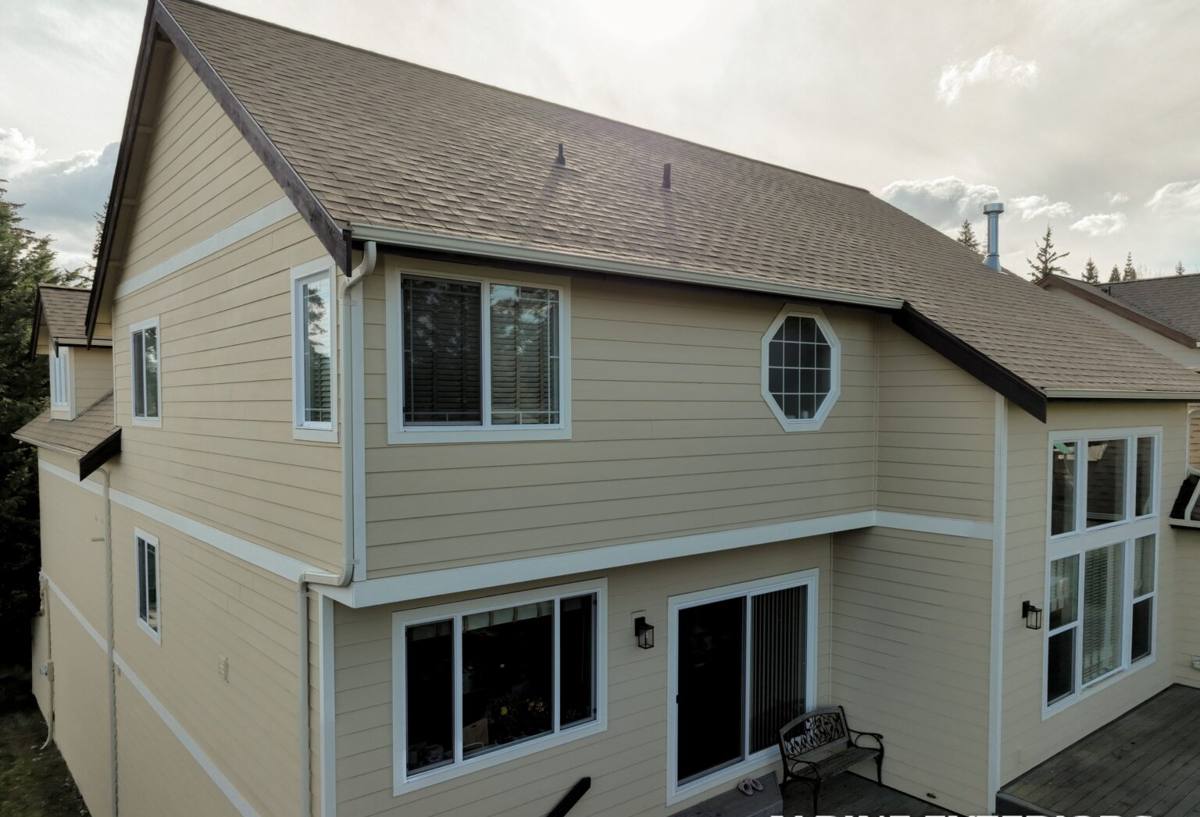
What Whatcom County's Climate Actually Does to Siding
Moisture That Doesn't Let Up
Bellingham gets a long rainy season, and unlike a quick summer downpour somewhere drier, this is sustained, driving rain that hits siding at an angle for days at a time. Siding that isn't dimensionally stable, or that relies on paint film or factory primer alone to keep water out, starts to show it — swelling at seams, softening at the bottom courses, or letting moisture track behind the cladding where it can sit against the sheathing.
Moss, Algae, and Shade
Between the tree cover common to Sudden Valley lots and the region's humidity, moss and algae growth on siding, trim, and fascia is a near-constant maintenance issue. Porous or textured surfaces give moss more to grip onto, and once it's established it holds moisture against the material even longer, accelerating whatever damage the rain alone would cause.
Salt Air Off the Bay
Proximity to Bellingham Bay means an added dose of salt-laden moisture in the air, which is harder on fasteners, metal flashing, and any siding material that isn't engineered to resist moisture absorption. Salt air speeds up corrosion at nail heads and trim joints and adds another reason surface-level protection (like a coat of paint) isn't enough on its own.
What Local Homes Need From Their Siding
- Dimensional stability so seams and joints stay tight through repeated wet-dry cycles
- A factory-applied finish that isn't dependent on the homeowner repainting every few years
- A surface that doesn't feed moss and algae the way porous or wood-based products can
- Corrosion-resistant fastening and flashing details at every penetration and seam
- Fire resistance, which matters across Washington regardless of coastal humidity
- A product line engineered for the specific moisture load of the Pacific Northwest, not just adapted from a national spec
James Hardie's HZ10 product line was engineered specifically for climates like ours — colder, wetter regions where moisture resistance matters more than heat resistance. That's a meaningful distinction: siding designed for the Southeast or Southwest is optimized for different stresses than siding designed for the Pacific Northwest, and installing the wrong regional formulation is a mistake we don't make.
Why We Only Install James Hardie
We get asked why we don't offer vinyl, LP SmartSide, or other fiber cement brands like Allura or Cemplank. The honest answer is that we looked at what each of those products does well and where it falls short in this climate, and we decided we'd rather do one product exceptionally well than offer several and cut corners on any of them.
| Factor | Why It Matters Here |
|---|---|
| Moisture behavior | Fiber cement resists swelling and rot better than wood-based composite siding in sustained rain |
| Finish durability | ColorPlus factory finish is baked on and warrantied, reducing repaint cycles in a climate that's hard on paint |
| Fire resistance | Non-combustible material, an advantage regardless of coastal vs. inland location |
| Climate engineering | HZ10 formulation is built for cold, wet regions specifically — not a one-size-fits-all national product |
| Warranty structure | Long, transferable manufacturer warranty backed by a company with decades in the fiber cement business |
Vinyl siding is inexpensive and low-maintenance in some respects, but it can warp in temperature swings, doesn't hold paint if you ever want to change the color, and has seams and J-channels that give moss and grime somewhere to collect. LP SmartSide and other wood-strand products perform reasonably when installed and maintained exactly to spec, but they're wood-based, meaning edge sealing and caulking maintenance is not optional — miss a cycle in a climate this wet and moisture finds the exposed wood fiber. We'd rather not sell a product whose long-term performance depends that heavily on a homeowner's maintenance schedule.
What a Correct James Hardie Installation Involves
Substrate and Moisture Barrier
Before any siding goes up, we check the sheathing for existing rot or moisture damage, address it, and install a proper weather-resistive barrier. Skipping this step is the single most common cause of siding failure regardless of what material goes on top — it's not the siding itself that fails first, it's what's happening behind it.
Flashing at Every Penetration
Windows, doors, vents, hose bibs, light fixtures — every penetration through the siding is a potential water entry point. Correct flashing detail at each one is what keeps driving rain from tracking behind the cladding, which matters more here than in drier climates because the rain has more opportunities to find a gap.
Fastening and Gapping
James Hardie specifies exact nailing patterns, fastener types, and gapping tolerances for expansion. Installing it like standard lap siding — nailing too tight, using the wrong fasteners, or skipping the required gaps — voids the manufacturer warranty and defeats the point of buying a premium product in the first place.
Caulking and Sealant Details
Hardie's ColorPlus finish is factory-cured and durable, but joints, corners, and trim intersections still need the correct sealant, properly tooled. In a climate with this much sustained moisture, a sloppy caulk line at a butt joint is exactly where water starts working its way in.
Our Process, Start to Finish
- Free on-site estimate — we walk the exterior, check existing siding and sheathing condition, and note anything specific to shade, drainage, or moss exposure on your property
- Detailed written proposal — product line, color, trim details, and a clear scope of work, no vague allowances
- Substrate prep — repair any rot or damage found once old siding comes off, before anything new goes up
- Weather barrier and flashing install — the part of the job nobody sees but that determines how the siding performs in ten years, not just year one
- Hardie siding installation — installed to manufacturer spec for fastening, gapping, and joint treatment
- Trim, caulking, and final detail work — the finish work that keeps water out at every seam and corner
- Final walkthrough — we go over the finished job with you before calling it complete
Why a Crew That Already Works Bellingham and Sudden Valley Matters
Siding installation isn't just about following a spec sheet — it's about knowing how a particular house type sits in a particular climate. A crew that regularly works Sudden Valley and greater Bellingham has already seen how homes on shaded, tree-lined lots handle moss compared to more open lots closer to the water, and how flashing details that hold up fine in a milder climate can fail here within a few seasons. That local repetition is what keeps us from treating every job as a generic install and instead building in the details this specific climate demands.
It also means we're not guessing at permitting, typical local construction (a lot of homes in this area share similar era and framing characteristics), or how a given color will actually look against the region's muted, tree-heavy light — Hardie colors read differently under overcast Pacific Northwest skies than they do in a sunnier climate, and it helps to have seen that in person before recommending one.
Maintenance: What Ongoing Care Actually Looks Like
One of the real advantages of James Hardie in this climate is how little maintenance it demands compared to wood-based or vinyl alternatives — but "low maintenance" isn't "no maintenance." Here's what actually keeps it performing well long-term in a Bellingham-area climate:
- Periodic gentle rinse to keep moss and algae from getting a foothold, especially on shaded or north-facing walls
- Visual check of caulked joints every year or two, since sealant is the one component that does wear over time
- Keeping gutters and downspouts clear so water isn't sheeting down the siding face during heavy rain events
- Trimming back vegetation that keeps siding shaded and damp longer than it needs to be
None of this compares to the repainting, caulk-chasing, and edge-sealing maintenance that wood-based composite siding requires in this climate, which is a big part of why we point homeowners toward Hardie in the first place.
Cost Factors to Understand Before You Get Quotes
| Factor | Why It Affects Price |
|---|---|
| Existing siding removal | Tear-off and disposal adds labor versus a bare wall |
| Sheathing/substrate condition | Rot repair found during tear-off is priced once it's visible, not guessed in advance |
| Home size and complexity | Multiple stories, dormers, and cut-up wall lines take more labor per square foot than a simple rectangular elevation |
| Siding profile and trim package | Lap siding, shingle-style panels, and trim detail level all vary in material and labor cost |
| Color selection | Standard ColorPlus colors versus custom or premium options can shift material pricing |
We don't quote off square footage alone over the phone — an accurate number requires seeing the actual condition of your walls, which is part of why the estimate visit matters.
Get a Straight Answer for Your Home
If your siding is showing moss buildup that keeps coming back, paint that won't hold, or soft spots near the bottom courses, it's worth having someone look at it before those problems reach the sheathing underneath. We'll walk your Bellingham or Sudden Valley property, give you a straight read on what's going on, and put together a free, no-pressure estimate for a James Hardie installation built for this climate — use the form below to get started.