 Sudden Valley Roofing
 Cordata's Weather Is Harder on Siding Than It Looks
Cordata sits in a part of Whatcom County where the weather doesn't do any one thing extreme — it just does several moderately damaging things, constantly, for most of the year. Storms coming off the water bring wind-driven rain that hits siding at an angle instead of falling straight down, which pushes moisture into seams and laps that a calmer climate would never test. Periods of onshore wind carry salt-laden air inland, and that salt settles into any crack, fastener head, or worn finish it can find. Add a moss season that, realistically, runs most of the year in this part of the Pacific Northwest, and you have a climate that is quietly aggressive toward exterior materials even when it never produces a single dramatic storm.
None of these factors is dramatic on its own. The problem is that they overlap. A siding product only has to fail at one of these — moisture resistance, finish durability, or resistance to organic growth — for the other two to accelerate the damage. That's the real design challenge for siding in Cordata and the surrounding Whatcom County area: not surviving one bad storm, but holding up to a slow, year-round combination of wet and damp.
What This Does to the Wrong Siding
Wood-based siding products absorb moisture at cut edges and joints, and once damp, they stay damp longer in a climate that doesn't get many stretches of dry, sunny days to let materials fully dry out. That trapped moisture is exactly what moss and mildew need to take hold. Site-applied paint finishes chalk and lose adhesion faster under repeated wet-dry cycling, which opens up hairline cracks that moisture and salt exploit. Even products marketed as low-maintenance can underperform here if their finish isn't engineered for a coastal, high-precipitation climate — the issue usually isn't the base material, it's what happens where the finish meets the weather over years, not months.
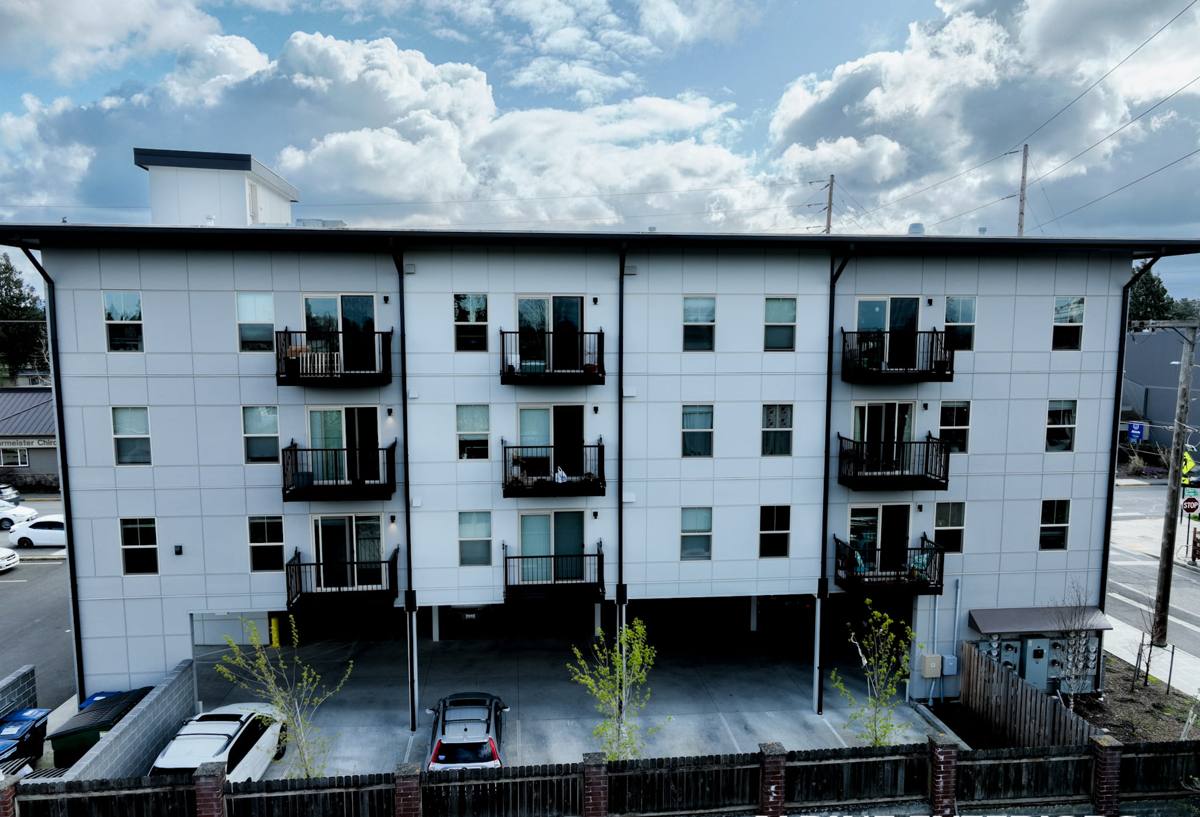
Why We Install James Hardie in This Climate — And Only James Hardie
We standardized on James Hardie fiber cement siding for every home we work on, including in Cordata, because it's engineered to handle exactly the conditions described above. Hardie siding is made from cement, sand, and cellulose fiber — a composition that doesn't swell, rot, or delaminate the way wood-based products can when they take on moisture. It's also non-combustible, which matters to insurers and to homeowners thinking long-term about risk, regardless of climate.
For this region specifically, Hardie's HZ5 product engineering is built for climates with sustained moisture exposure — the freeze-thaw and wet-weather conditions common across the Pacific Northwest. The ColorPlus finish is baked on at the factory under controlled conditions, which gives it a tighter, more consistent bond to the substrate than a field-applied coat can achieve. That matters here for a specific reason: a finish that stays fully adhered, without the microscopic cracking that comes from repeated wet-dry cycling, gives moss spores and mildew far less to grab onto in the first place. It doesn't make a home moss-proof — nothing does in this climate — but it removes one of the easiest footholds.
We don't install LP SmartSide, vinyl, or other fiber cement alternatives, and that's a deliberate standard, not an oversight. Each of those products has legitimate uses elsewhere. We chose to specialize in one system, install it correctly every time, and stand behind it, rather than carry multiple products and split our attention and expertise across all of them.
What a Correct Installation Actually Involves
Fiber cement siding performs exactly as well as its installation. James Hardie's own warranty terms and installation instructions are specific for a reason — most siding failures blamed on the product are actually installation shortcuts. In a wet climate like Cordata's, those shortcuts show up faster and more visibly than they would somewhere drier.
The details that actually matter
- Correct clearance between the bottom edge of siding and grade, decks, roofing, and other horizontal surfaces, so water has nowhere to wick upward
- A weather-resistive barrier installed and lapped correctly behind the siding, with a drainage plane so any moisture that does get past the surface can escape
- Fasteners of the correct type, length, and spacing, driven per Hardie's fastening schedule — not just "close enough"
- Flashing at every horizontal joint, window head, and butt seam, not just at obvious transitions
- Kick-out flashing at every roof-to-wall intersection, which is one of the single most common sources of hidden water damage in wind-driven rain climates
- Caulking only at the joints Hardie specifies — over-caulking traps moisture just as reliably as under-caulking lets it in
- Factory-cut and field-cut edges properly sealed before installation, not left raw
Any one of these done wrong might not show a problem for a year or two. In Cordata's climate, it usually doesn't take much longer than that for it to become visible — as a stain, a soft spot, or a section of moss that grows faster than the rest of the wall.
James Hardie Product Lines for Cordata Homes
Hardie makes several product lines, and the right one depends on the home's architecture and exposure, not just personal preference. Here's how the main options compare for the kind of housing stock common in this area:
| Product | Look | Where It Fits Best |
|---|---|---|
| HardiePlank Lap Siding | Traditional horizontal lap | Most common choice; performs well on all exposures when laps and flashing are done correctly |
| HardiePanel Vertical Siding | Clean vertical lines, often with battens | Modern or craftsman-style homes; needs careful joint treatment given more seams per square foot |
| HardieShingle | Staggered or straight shingle profile | Accent gables, dormers, and homes going for a coastal or cottage look |
| Board & Batten | Wide vertical boards with trim battens | Accent walls, entries, and modern farmhouse-style exteriors |
Many homes end up using a combination — lap siding as the primary field material with shingle or board-and-batten accents on gables or entry features. That mix is common in this part of Whatcom County and doesn't create a maintenance problem as long as the transitions between materials are flashed correctly.
ColorPlus Finish and Long-Term Maintenance
Color and finish decisions matter more here than in drier climates, because the finish is the first line of defense against moss staining and salt exposure. ColorPlus factory finish and standard field-applied paint behave differently over time:
| Factor | ColorPlus Factory Finish | Field-Applied Paint |
|---|---|---|
| Application | Baked on under controlled factory conditions | Applied on-site, subject to weather during application |
| Finish warranty | Backed by a separate finish warranty from Hardie | Typically covered by the paint manufacturer's standard warranty, if any |
| Repaint interval | Extended well beyond typical repaint cycles | Usually needs repainting on a shorter, more conventional cycle |
| Touch-up needs | Touch-up paint available for nicks and cuts | Full-wall repaint often needed once finish starts failing unevenly |
We install ColorPlus finishes as our standard for this reason. In a climate with this much moisture and organic growth pressure, a finish that holds its bond longer is directly tied to how long the siding looks and performs the way it should.
Our Process, Start to Finish
- On-site assessment — we walk the exterior, check exposures (especially west and southwest-facing walls, which typically take the worst of the driving rain here), and look at existing siding condition
- Moisture and sheathing check — where old siding is coming off, we check the sheathing and framing underneath for hidden rot before anything new goes up
- Written scope and product selection — a clear plan covering product lines, trim details, color, and any repairs needed, with no surprises added later
- Tear-off and prep — removal of old material, repair of any damaged sheathing, and installation of the weather-resistive barrier and flashing system
- Installation to Hardie specification — fastening schedule, clearances, and flashing done to manufacturer spec, not shortcuts
- Final walkthrough — we go over the finished work with the homeowner before calling the job done
- Warranty registration — proper registration so the transferable warranty is valid if the home changes hands later
Why Hiring a Crew That Already Works Cordata and Sudden Valley Matters
Siding crews that split their time across many different regions and climates tend to install to a generic standard. A crew that regularly works Whatcom County homes already knows which elevations take the worst of the wind-driven rain, how aggressive moss growth gets on north-facing walls under tree cover, and how salt exposure from onshore weather events plays into fastener and trim choices. That knowledge shapes decisions on every job — where extra flashing attention is worth it, which joints need the most careful sealing, and how to sequence a tear-off around a wet forecast instead of working through it.
Local familiarity also means fewer delays. Knowing local permitting expectations, typical HOA guidelines in planned communities, and which suppliers can get specific Hardie profiles and colors without a long wait all keep a project moving instead of stalling out mid-tear-off — which is the worst time for a home to sit exposed in this climate.
Cost Factors for a Cordata Siding Project
Every home is different, but the same handful of factors drive most of the cost variation we see on siding projects in this area:
| Factor | Why It Matters |
|---|---|
| Home size and stories | More square footage and height mean more material, labor, and equipment time |
| Tear-off vs. new construction | Removing and disposing of old siding, and repairing any hidden damage found underneath, adds time and cost |
| Trim and architectural detail | Gables, dormers, multiple siding profiles, and custom trim all add labor |
| Accessibility | Tight lot lines, landscaping, or difficult roof lines can slow staging and installation |
| Color and profile | Standard ColorPlus colors and common profiles are typically more readily available than custom orders |
| Extent of hidden moisture damage | Sheathing or framing repairs found during tear-off are the most common source of scope changes |
We give homeowners a clear, written scope before work starts, and we flag anything that changes that scope — like hidden rot — before proceeding, not after.
Living with Hardie Siding in a Moss-Heavy, Salt-Air Environment
Correctly installed Hardie siding is genuinely low-maintenance, but "low-maintenance" isn't the same as "no maintenance" in this climate. A little routine care goes a long way toward getting the full lifespan out of the system:
- Rinse the siding down with a garden hose once or twice a year to clear settled organic material and salt residue before it builds up
- Keep gutters and downspouts clear so overflow doesn't run down the wall face repeatedly
- Trim back vegetation and tree limbs that shade siding and keep it damp longer than the rest of the exterior
- Check caulking at trim and joints every year or two, and have any cracked or missing sections redone promptly
- Avoid high-pressure washing directly at joints and edges — it can force water behind properly installed flashing
- Watch for early moss growth on nearby roofing or fences as an early signal of how much moisture pressure that side of the house is under
None of this is heavy upkeep. It's the kind of basic attention that any exterior in this region benefits from, and it's a lot less work than the repainting and patching cycle that comes with less climate-appropriate siding choices.
If you're weighing a siding project for a home in Cordata or anywhere around Sudden Valley, we're happy to take a look and walk you through what your home actually needs — no pressure, no obligation. Reach out for a free estimate using the form below.