 Sudden Valley Roofing
 Why Edgemoor Siding Takes More Punishment Than People Expect
Homes in the Edgemoor area near Sudden Valley deal with a specific combination of stresses that most siding products simply weren't built to handle over the long haul. Salt-laden air works into seams and fastener heads. Driving rain, pushed sideways by wind rather than falling straight down, finds its way behind loose trim and under lifted caulk joints. And Whatcom County's long, wet moss season keeps siding surfaces damp for weeks at a stretch, which accelerates rot wherever water has already gotten a foothold.
None of these forces cause damage overnight. They work slowly, at the seams, corners, and penetrations where siding meets trim, windows, and roof lines. By the time a homeowner notices a soft spot or a stain, the underlying damage has usually been building for a season or two. That's the pattern we see most often on repair calls in this part of Sudden Valley: small, ignorable problems that grew into something that needed real attention.
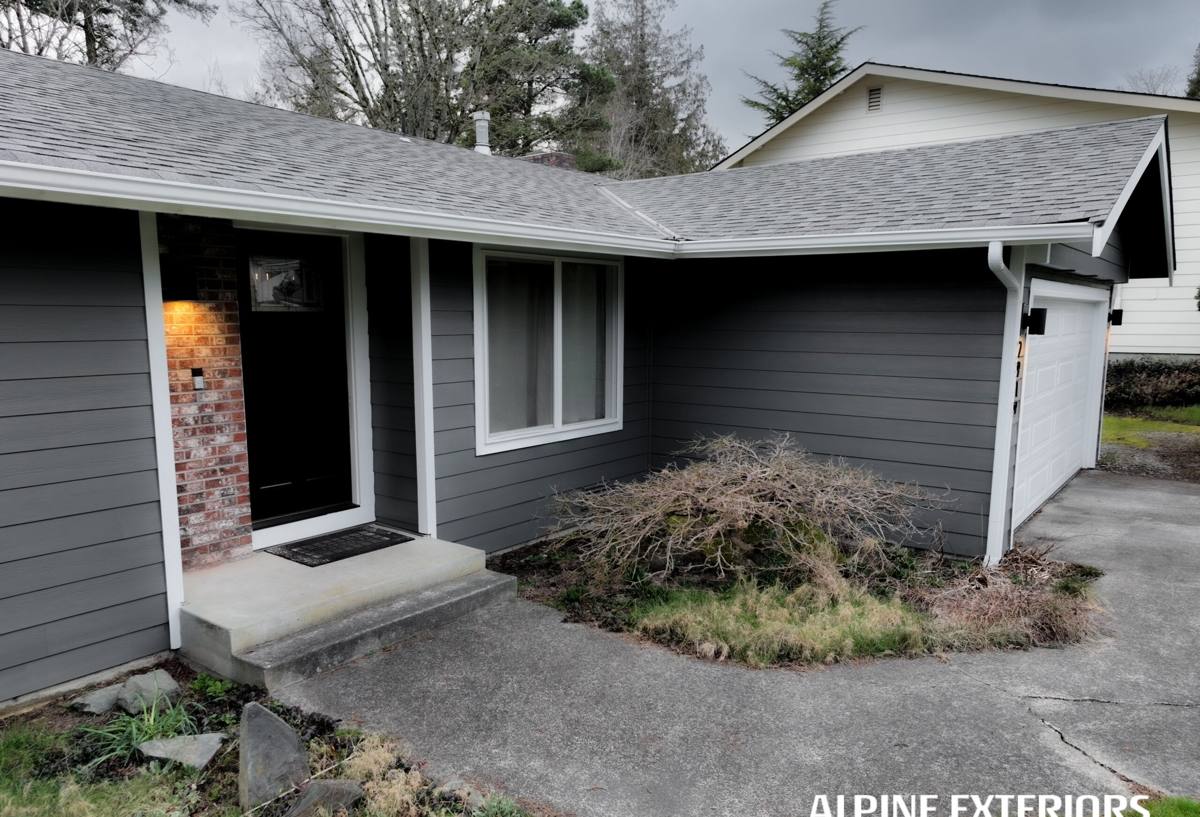
Signs Your Siding Needs Repair, Not a Full Replacement
Not every siding problem means tearing off the whole wall. Most of the calls we run in Edgemoor are legitimate repairs — targeted fixes to specific failure points while the rest of the siding is still sound. Here's what typically points to a repair rather than a full re-side:
- Soft or spongy siding in one localized area, usually near a window, deck ledger, or downspout
- Visible cracking or chipping at panel edges or corners, but the field of the siding is intact
- Persistent moss or algae staining concentrated on one section rather than the whole elevation
- A section of siding that was damaged by a falling branch, ladder contact, or an impact
- Caulk joints that have failed and let water behind the siding at trim boards or corner posts
- Fastener heads popping out or leaving rust streaks in a limited area
- Discoloration or bubbling on the surface finish without soft wood underneath
If the damage is widespread — soft siding across multiple elevations, systemic moisture intrusion behind the weather barrier, or a product that's simply reached the end of its service life — a repair is a temporary patch, not a fix. Part of an honest inspection is telling you which situation you're actually in.
What a Correct Siding Repair Job Actually Involves
It's Not Just Swapping a Board
A siding repair that holds up in this climate has to address more than what's visible on the surface. Pulling a damaged section and nailing up a replacement piece without checking what's behind it just seals the same moisture problem back into the wall.
Checking the Water-Resistive Barrier
Every proper repair starts with opening the damaged area enough to inspect the house wrap or building paper underneath. If it's torn, compressed, or missing at the point of failure, that gets corrected before anything new goes back on. Skipping this step is the single most common reason a "repaired" section fails again within a year or two.
Flashing and Drainage Details
A large share of siding failures near Edgemoor trace back to a flashing detail that was missing or installed wrong in the first place — at a window head, a deck ledger, or a roof-to-wall transition. A repair has to correct that detail, not just cover it up, or the new siding will fail in the same spot for the same reason.
Matching the Existing Material and Finish
Once the wall assembly is right, the visible repair needs to match the surrounding siding in profile, exposure, and finish so it doesn't stand out as an obvious patch. This is where the product matters — some materials are far easier to match seamlessly than others, which we cover below.
Repair or Replace: How to Tell the Difference
| Situation | Repair usually makes sense | Full replacement is the better call |
|---|---|---|
| Extent of damage | Confined to one or two localized areas | Present across multiple walls or elevations |
| Age of existing siding | Siding is mid-life and otherwise performing well | Siding is near or past its expected service life |
| Moisture behind the wall | Isolated to the damaged section | Found at multiple points, suggesting a systemic barrier failure |
| Material match | Current product is still available or closely matchable | Product is discontinued or has faded/weathered beyond a workable match |
| Underlying cause | A single identifiable event (impact, one failed flashing detail) | An ongoing, unresolved moisture or ventilation problem |
We'll walk you through where your home falls on that table before recommending anything. A repair should solve the problem for good, not just buy a season or two.
Why We Repair — and Replace — With James Hardie Fiber Cement Only
We don't stock or install vinyl siding, LP SmartSide, Cemplank, Allura, primed spruce, or cedar. That's a deliberate standard, not a matter of what happened to be on the truck. When we're patching in a repair section, the product we use matters just as much as the workmanship, because a repair is only as good as its weakest material.
James Hardie fiber cement is non-combustible, dimensionally stable in wet climates like this one, and available with a factory-applied ColorPlus finish that's formulated to hold color and resist the fading that makes patch repairs obvious on other materials. That last point matters more than people expect: a vinyl or wood repair piece almost always looks slightly different from the surrounding siding within a year, because the original material has already weathered and the new piece hasn't. Hardie's engineered HZ product lines and factory finish process are built to minimize exactly that mismatch, and the product carries a strong transferable warranty when installed to manufacturer spec — something that matters if you ever sell the home.
We're not going to tell you vinyl or LP SmartSide are bad products across the board — they have real strengths, particularly on upfront cost. But once we made the decision to stand behind our repair work with one material system, fiber cement was the one that held up to the trade-offs we cared about most: moisture behavior over time, color stability, and long-term maintenance burden on the homeowner. So that's what goes on every home we touch, repair or full re-side.
Our Siding Repair Process for Edgemoor Homes
1. On-Site Inspection and Diagnosis
We look at the damaged area and the surrounding siding, check for soft spots with a probe, and identify the likely cause — impact, flashing failure, caulk failure, or moisture migration. We'll tell you plainly if what you're looking at is cosmetic or structural.
2. A Written Scope Before Anything Is Cut Open
You get a clear explanation of what we found, what we're planning to do about it, and roughly what it will cost, before we start removing material. No surprise change orders for problems we should have caught during inspection.
3. The Repair Itself
Damaged siding and any compromised barrier material come out. We correct the underlying cause — a flashing detail, a failed sealant joint, damaged house wrap — then install matching Hardie fiber cement, fastened and finished to manufacturer spec.
4. Cleanup and Documentation
We clean up debris and old material, and if the work falls under a manufacturer or workmanship warranty, we make sure you have that documentation on hand.
Why a Crew That Already Works This Area Matters
Siding repair is a trade where local experience actually changes the outcome, not just the sales pitch. A crew that's worked repair calls around Sudden Valley and the broader Whatcom County area already knows which failure points show up again and again in this climate — which flashing details tend to be missed on homes of a certain age, which elevations take the worst of the wind-driven rain, and how much moss buildup is normal wear versus a sign of a bigger moisture problem underneath.
That familiarity also shows up in smaller, practical ways: knowing what Hardie profiles and colors are actually in regional supply so a repair can be matched without a long special-order wait, and understanding that communities like Sudden Valley often have their own architectural or exterior guidelines worth checking before work starts. None of that is complicated, but it's the difference between a repair that gets done right the first time and one that turns into a longer project than it needed to be.
Keeping Repaired Siding Protected Long-Term
A correct repair should last as long as the surrounding siding, but a little maintenance keeps it that way through this region's wet, moss-prone seasons:
- Keep gutters and downspouts clear so water isn't overflowing onto siding below the roofline
- Trim back tree cover that keeps siding shaded and damp for extended periods
- Rinse moss and algae buildup off siding surfaces before it has a chance to hold moisture
- Re-caulk trim and penetration joints if you notice cracking or gaps forming
- Do a quick visual check after major storms for new cracks, dents, or lifted panels
Fiber cement holds up well to this maintenance routine without the swelling, warping, or repeated repainting that other siding materials often demand in a climate like this.
If you've got a soft spot, a stained section, or storm damage on your Edgemoor home, we're happy to take a look and give you a straight answer on what it actually needs. Reach out for a free, no-pressure estimate — there's a form right below to get started.