 Sudden Valley Roofing
 Why Sehome Decks Take More Damage Than You'd Expect
Decks in and around Sehome don't fail because the lumber was bad or the builder cut corners on day one. They fail because Whatcom County weather is patient and relentless: months of driving rain, humidity that never fully clears, and a moss season that can run from early fall through late spring. A deck that would last fifteen years in a dry climate can start showing real structural problems in half that time here if it isn't built and maintained with this specific weather pattern in mind.
Salt-laden air off the Sound works on fasteners and hardware the same way it works on car undercarriages — slowly, quietly, until a bolt that looked fine snaps off in your hand. Combine that with standing moisture under decking boards and around ledger connections, and you get a very specific failure pattern that we see over and over on repair calls in this area: good-looking decks with quietly rotten bones underneath.
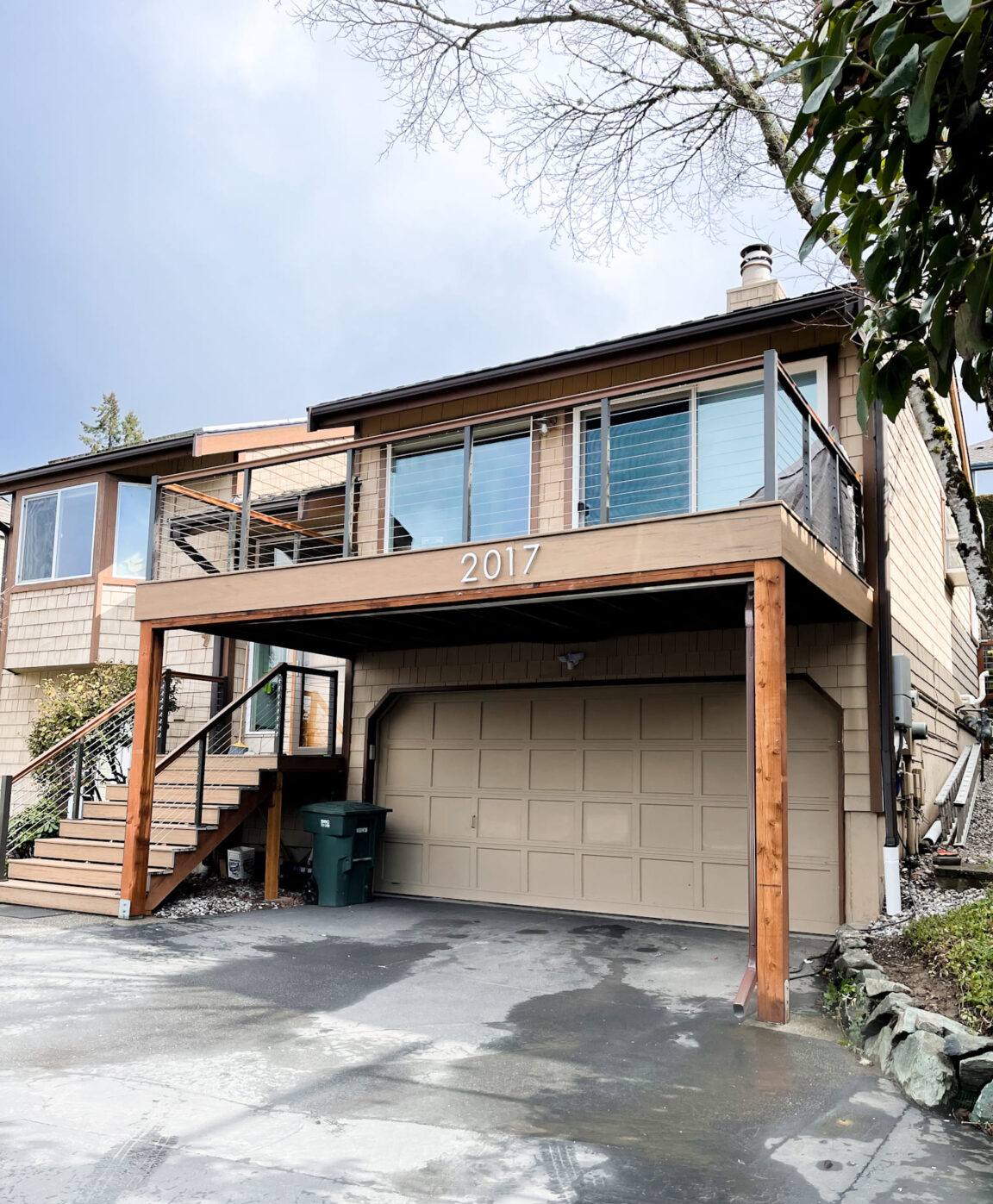
Signs Your Deck Needs Repair, Not Just Cleaning
A pressure wash and a coat of stain can make a tired deck look better without fixing what's actually wrong. Here's what should prompt an actual repair inspection rather than a weekend cleaning project:
- Boards that feel spongy or flex noticeably when you walk across them
- Any soft spot you can push a screwdriver into more than a quarter inch
- Railings or posts that wiggle when you push on them from the side
- Rust streaking below fasteners, joist hangers, or the ledger board
- Gaps opening up where the deck meets the house, or daylight visible at the ledger
- Persistent black-green growth that comes back within weeks of cleaning
- Stairs that feel uneven or where stringers show visible cracking
If you're seeing more than one of these, the issue is usually below the surface, not on it.
What Actually Fails First: Structure Before Boards
Homeowners usually notice the decking — the boards you walk on — first, because that's what's visible. But in our experience the structure underneath is almost always the bigger concern, and it's the part that gets missed by anyone who isn't looking for it specifically.
Ledger and Flashing
The ledger board — where the deck bolts to the house — is the single most common point of hidden rot we find on repair calls. If the flashing behind it was installed wrong, or wasn't installed at all, rainwater tracks straight down between the house wall and the deck framing for years without anyone noticing, because the damage is hidden behind the rim joist. By the time it shows up as a soft spot or a sag near the house, there's usually been water intrusion for a long time already.
Framing and Joists
Joists and beams are pressure-treated on the outside, but any cut end, notch, or drilled hole exposes untreated wood underneath. Combined with poor drainage or debris buildup between boards, that's where rot starts even on a deck that otherwise looks solid.
Fasteners and Hardware
Nails, screws, and joist hangers that aren't rated for ground contact or coastal exposure corrode faster here than in drier inland climates. Corroded hardware doesn't just look bad — it loses holding strength, which is a safety issue on stairs, railings, and ledger connections specifically.
Decking and Railings
The visible boards and rails usually fail last, and they're the easiest and cheapest part to address — which is exactly why a repair estimate should never stop at "the boards look worn." A quote based only on what's visible from the top misses most of the actual problem.
Repair, Partial Rebuild, or Full Replacement
Not every deck problem needs a full teardown, and not every deck can be saved with a few new boards. The honest answer depends on how far the damage has spread into the structure versus staying isolated in the surface decking.
| Situation | Typical Fix | What Drives the Decision |
|---|---|---|
| A few soft or cracked boards, structure sound | Board-by-board replacement | Localized damage, structure tests solid underneath |
| Loose railings, wobbly posts | Hardware and post reinforcement | Usually a fastener or connection issue, not rot |
| Soft spot near the house wall | Ledger and flashing repair | Almost always a water intrusion problem, needs opening up to confirm extent |
| Rot in multiple joists or beams | Partial structural rebuild | Framing repair costs approach rebuild costs quickly once several members are involved |
| Widespread rot, undersized original framing, or code issues | Full replacement | Often cheaper long-term than chasing repairs on a deck built to old or minimal standards |
We give you the honest version of that table for your specific deck, not the version that talks you into the biggest job. If board replacement is genuinely the right call, that's what we'll recommend.
Material Choices for a Long-Term Fix
What we rebuild with matters as much as how we rebuild it. Every material has real trade-offs — we'll walk you through them honestly rather than pushing whatever's most profitable to install.
| Material | Upfront Cost | Maintenance | How It Handles This Climate |
|---|---|---|---|
| Pressure-treated lumber | Lowest | Needs re-staining/sealing every 2-3 years | Good if maintained; ignored maintenance shortens life fast in wet conditions |
| Cedar | Moderate | Regular sealing to hold color and resist checking | Naturally rot-resistant but still needs upkeep against the long wet season |
| Composite decking | Highest | Occasional cleaning, no staining | Very stable in moisture; framing underneath still needs the same care |
One honest caution on composite: it solves the surface maintenance problem, but it doesn't solve a bad ledger connection or rotten framing underneath. We won't install composite decking over structure we haven't verified first — that just hides a problem under a nicer-looking surface, and it comes with warranty terms that assume the substrate underneath was done right.
Moss, Algae, and the Long Wet Season
Whatcom County's moss season isn't a minor cosmetic nuisance — moss and algae hold moisture against the wood surface and in board gaps, which accelerates the exact rot patterns described above. A deck that's cleaned and maintained on a schedule ages very differently from one that isn't.
- Sweep debris out of board gaps regularly through fall and winter — trapped leaves and needles hold moisture longest
- Keep gutters and downspouts clear so runoff isn't dumping extra water directly onto deck framing
- Check for standing water after heavy rain — pooling anywhere on the deck surface means drainage or slope needs attention
- Re-seal or re-stain wood decking on the schedule the product actually calls for, not "whenever it looks dry"
- Have fastener and connection points checked periodically, especially near the ledger and stair stringers
Our Deck Repair Process
- Full inspection first. We check the ledger connection, framing, and hardware before ever talking about boards — that's where the real problems usually are.
- Honest scope, in writing. You get a clear explanation of what's failing, why, and what level of repair actually addresses it — not a padded worst-case quote.
- Open up what needs opening. If we suspect hidden rot at the ledger or framing, we confirm it before quoting rather than guessing.
- Repair to code, not just to "look fixed." Ledger flashing, guardrail connections, and structural framing get repaired to meet current building code requirements, since a deck permit or resale inspection will check for exactly that.
- Match materials and finish. Repaired sections get treated so they weather in with the rest of the deck rather than standing out as an obvious patch.
- Walk it with you before we leave. You should understand what was fixed and what maintenance keeps it that way.
Why a Crew That Already Works Sehome Matters
Deck repair done wrong in a dry climate might just look a little rough. Deck repair done wrong here — where wind-driven rain and salt air are part of the daily reality, not the exception — turns into a repeat problem within a couple of seasons. A crew that already works in Sehome and around Sudden Valley knows what to check first, because we've seen the same failure patterns on enough decks in this specific area to know where they usually start.
That local familiarity also matters for anything involving permits or neighborhood guidelines. Some properties in planned communities around Sudden Valley have exterior standards to follow for visible structures like decks, and it's easier to get that right the first time than to redo work after the fact. A crew that's local knows to ask the right questions upfront instead of finding out after the job's done.
We're a roofing and exteriors crew that treats deck repair the same way we treat a roof: fix what's actually failing, be straight about what it takes, and build it to hold up against the weather this area actually gets — not the weather a lumber tag assumes.
If you've got a deck in the Sehome area that's showing any of the signs above, we're glad to take a look. Estimates are free, there's no pressure, and you'll get a straight answer about what your deck actually needs — use the form below to get started.