 Sudden Valley Roofing
 Why Sunnyland Siding Takes a Different Kind of Beating
Sunnyland homes sit in a stretch of Whatcom County where three things work against exterior siding at the same time: salt-laden air off the water, wind-driven rain that doesn't just fall straight down but gets pushed sideways into laps and seams, and a moss season that runs longer here than in drier parts of the state. None of these on their own is unusual for western Washington. Together, on the same wall, they age siding faster than most homeowners expect — especially siding that wasn't engineered or installed with that combination in mind.
Salt air is corrosive to exposed metal fasteners and trim, and it can leave a fine residue on painted surfaces that breaks down finishes over time. Driving rain finds any gap in a wall assembly — around window and door trim, at butt joints, behind loose caulk — and pushes water where it doesn't belong instead of letting it run off. And moss, which thrives in the shaded, damp conditions common on north- and east-facing walls near mature tree cover, holds moisture against the siding face for weeks at a stretch. On wood-based products, that's a direct path to rot. On the wrong installation, it's a path to trapped moisture behind the cladding, which you don't see until the damage is already done.
None of this means siding in Sunnyland or the broader Sudden Valley area is a losing battle. It means the material and the installation both have to be chosen for this specific climate, not for a national average.
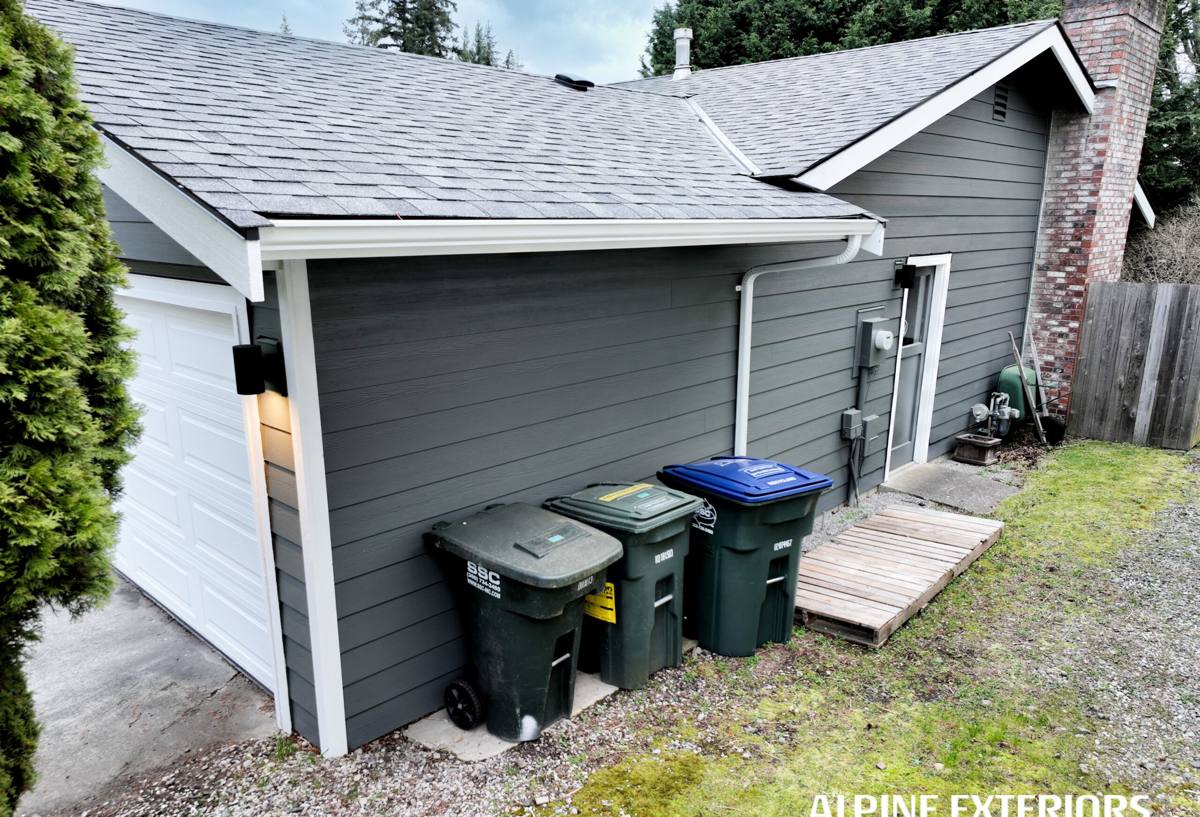
What a Correct Siding Installation Actually Requires Here
Weather-Resistive Barrier and Drainage Plane
Behind every siding product should be a continuous weather-resistive barrier, lapped correctly from bottom to top so water sheds outward rather than working its way in at the seams. In a climate with as much driving rain as Whatcom County sees, we also pay close attention to the drainage plane — the space that lets any water that does get behind the siding find its way back out instead of sitting against the sheathing.
Flashing at Every Penetration
Every window, door, hose bib, vent, and light fixture is a place where water can get behind the wall if the flashing isn't done right. Correct flashing isn't a bead of caulk over a gap — it's a layered, lapped system that directs water down and out, the same way shingles direct water down a roof. This is the single most common place a siding job fails, and it's invisible once the siding goes back on, which is exactly why it has to be done right the first time.
Fastening Schedule and Clearances
Fiber cement siding has a manufacturer-specified fastening pattern, and it matters — nails placed wrong or driven too hard or too soft can crack boards or let them work loose over years of wind and temperature swings. Ground clearance and clearance from roof lines, decks, and grade also matter more here than in dry climates, because they control how much standing moisture and splash-back the bottom courses are exposed to during our long wet season.
Why We Install Only James Hardie Fiber Cement
We standardized on James Hardie fiber cement siding for every home we side, and we don't install vinyl, LP SmartSide, Cemplank, Allura, primed spruce, or cedar. That's not a marketing position — it's a decision built around what actually holds up in a climate like this one.
Fiber cement is non-combustible, which matters as wildfire smoke seasons have become a more regular part of the Pacific Northwest calendar. It doesn't feed moss and mildew growth the way wood-based products can, which is a real advantage on the shaded walls that are common around Sudden Valley's tree cover. James Hardie's ColorPlus factory finish is baked on under controlled conditions rather than field-painted, which gives it better resistance to the fading and chalking that salt air and UV exposure cause over time. And Hardie's HZ5 product line is specifically engineered for climate zones like ours — colder, wetter regions where moisture cycling is the main threat to a wall assembly.
We're not going to tell you vinyl or LP SmartSide are bad products in every setting — they have real uses and real advantages elsewhere. But vinyl can warp and fade faster under UV and temperature swings, its seams and joints give water more places to get behind the wall, and it's not something we're willing to put our name behind in a climate this wet. Engineered wood products like LP SmartSide depend heavily on an intact factory coating and correct field sealing at every cut edge — miss one edge, in a climate with this much sustained moisture, and you've created a rot risk that won't show up for a few years. Cedar and primed spruce are honest, attractive materials, but they're wood, and wood in a long moss season means an ongoing maintenance commitment — restaining, recaulking, watching for soft spots — that most homeowners don't want to sign up for. Fiber cement, installed correctly, removes most of that maintenance burden and backs it with a strong transferable warranty.
Signs Your Siding in Sunnyland Needs Attention
- Dark green or black staining on the siding face, especially on shaded walls facing away from direct sun
- Soft spots or visible give when you press on the siding near the bottom courses or under windows
- Paint that's peeling, bubbling, or chalking heavily rather than just fading evenly
- Gaps opening up at corner boards, trim, or window and door casings
- Visible warping, cupping, or boards pulling away from the wall
- Rust streaking below fastener heads or trim hardware
- A musty smell near exterior walls inside the home, which can point to moisture already behind the siding
- Rising heating bills without an obvious cause, which sometimes traces back to a wall assembly that's no longer doing its job
Siding Material Comparison for This Climate
| Material | Moisture / Moss Resistance | Maintenance | Fire Rating | Typical Longevity |
|---|---|---|---|---|
| James Hardie fiber cement | Strong — doesn't rot, resists sustained moisture exposure | Low — factory finish, minimal repainting | Non-combustible | Long-lived when installed to spec |
| Vinyl | Moderate — seams and joints are moisture entry points | Low, but can warp or fade with age | Combustible | Variable, shorter in extreme temperature swings |
| Cedar / primed spruce | Weak in shaded, damp conditions without ongoing upkeep | High — restaining, recaulking, inspection | Combustible | Depends heavily on maintenance discipline |
| Engineered wood (LP-type) | Good if factory coating and cut edges stay sealed | Moderate — edge sealing is critical and easy to miss | Combustible | Good with diligent maintenance |
Our Installation Process
- Inspection and assessment — we look at the existing wall assembly, sheathing condition, and any moisture damage before quoting the job, not after we've already started
- Removal and prep — old siding comes off, sheathing is repaired or replaced where needed, and we don't cover up damage that should be fixed first
- Weather-resistive barrier and flashing — installed continuously and lapped correctly at every window, door, and penetration before a single piece of siding goes up
- James Hardie installation — installed to manufacturer spec for our climate zone, with correct fastening, clearances, and joint treatment
- Trim and detail work — corner boards, casings, and transitions finished so water sheds away from the home rather than pooling at joints
- Final walk-through — we go over the finished job with you before calling it done
Cost Factors for Siding Installation in Sunnyland
Every home is different, and we'd rather walk your property and give you a real number than throw out a figure that doesn't apply to your house. In general, these are the factors that move the price:
| Factor | Why It Matters |
|---|---|
| Home size and wall square footage | More surface area means more material and labor |
| Condition of existing siding and sheathing | Rot or moisture damage found underneath needs repair before new siding goes on |
| Home shape and detail work | Dormers, bump-outs, and lots of trim take more time than a simple rectangular wall |
| Product line and finish selection | Panel size, texture, and color line affect material cost |
| Site access | Tight lots, slopes, or limited staging area can add labor time |
Why Hire a Crew That Already Works in Sunnyland and Sudden Valley
A crew that regularly works this part of Whatcom County has already seen how homes here age — which walls tend to hold moss, which older siding types are failing first, and how much wind-driven rain a given exposure actually takes on. That's not something you can fully replicate from a spec sheet. It shows up in small decisions on the job: where to pay extra attention to flashing, which walls need a closer look at the sheathing before covering it back up, and how to sequence the work around our wet season instead of fighting it.
Being local also matters after the job is done. If a warranty question comes up or you want something checked five years down the road, you're calling a crew that's still working in your area, not chasing down a company that moved on to a different region.
Living With Your New Siding
James Hardie siding installed to spec is genuinely low-maintenance, but "low-maintenance" isn't "no-maintenance" in a climate that grows moss on everything left in the shade too long. Keep gutters clear so water isn't overflowing down the wall face, trim back vegetation that's shading and holding moisture against the siding, and do a periodic gentle rinse rather than an aggressive pressure wash, which can force water behind joints and trim. Beyond that, the ColorPlus factory finish is built to go a long time without repainting — which, in a place with this much rain, is exactly the kind of maintenance you want to avoid signing up for.
If your siding in Sunnyland or anywhere around Sudden Valley is showing its age, or you're planning ahead for a replacement, we're happy to take a look and give you a straight assessment — no pressure, no obligation. Reach out for a free estimate using the form below.